
The trust model
This is a focused read on the one idea that governs everything Plexus does with an agent's request: an agent that can reach the gateway still has zero authority by default. For the whole mental model in context, read the concepts first; this page goes deep on the trust machinery alone. For the adversarial view and the credential boundary, see the security model.
Default-deny is the whole promise
Reaching the gateway — even handshaking successfully — buys an agent knowledge of what the owner authorized for it, never the right to call anything. A successful handshake grants the agent's manifest — its owner-authorized subset, in complete detail — and grants nothing else. The agent never learns the gateway has more than what the owner selected for it. An agent that has never been granted a capability is denied at /invoke with grant_required.
Authority is something a human grants: scoped to specific capabilities, time-boxed, and revocable at any moment. It is never something the agent can take, infer, or self-assert.
Three clocks, not one
Plexus deliberately separates how long your approval stands, how long an agent's working episode lasts, and how long a single token lives:
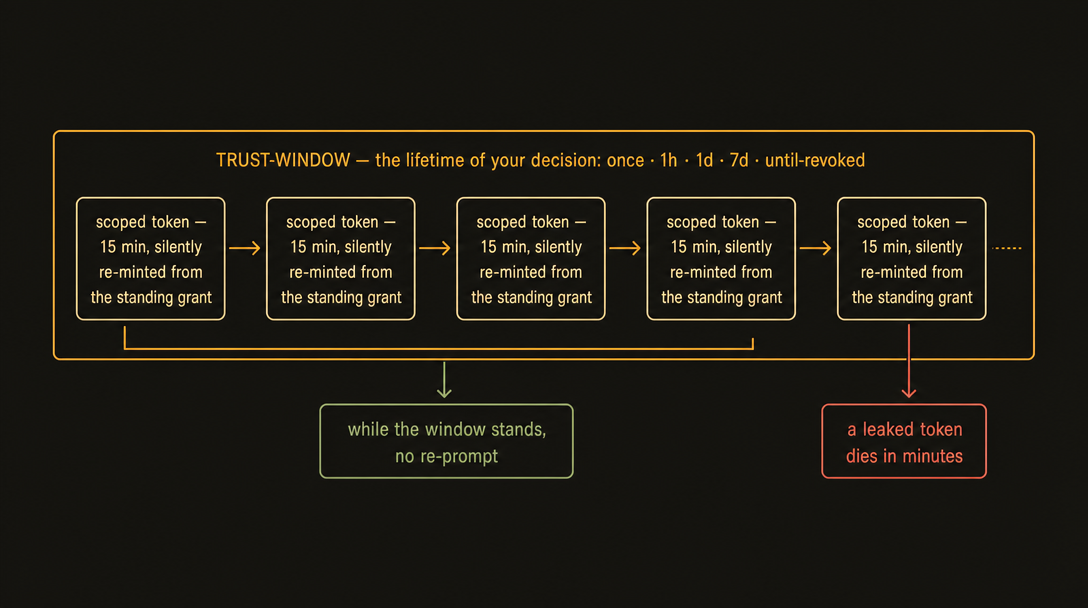
Trust-window — the lifetime of your decision. When you approve a grant you pick a window:
once,1h,1d,7d,until-revoked, or acustomduration. Until that window ends (or you revoke), the agent does not have to re-ask. This is the standing grant.Session — the episode clock: how long authority flows silently. Every handshake opens a session (in-memory, 60 minutes, dead on gateway restart), and both
POST /invokeandPOST /grants/refreshrequire the presenting token's session to still be live. When the episode ends, the chain of silent re-mints ends with it — only the agent's PAT, in a fresh audited handshake, opens the next episode.Scoped token — the blast radius. Every actual call carries a short-lived bearer token, default 15 minutes (
DEFAULT_TOKEN_LIFETIME_MS, clamped to[1m, 60m]). When it expires the agent silently re-mints a fresh one from the standing grant viaPOST /grants/refresh— no connection-key, no re-prompt — as long as the trust-window still stands. A leaked token is therefore worthless within minutes, even while the standing grant persists.
The three form a containment ladder: PAT (identity, durable) → session (episode, ≤ 1 h) → token (blast radius, ~15 min). Each rung down is shorter-lived and narrower, and stealing a lower rung never climbs back up: a leaked token dies in minutes; a leaked token plus its refresh path is still capped by the episode it was minted in; only the PAT opens new episodes, and every opening is an audited handshake. This is why a long trust-window — until-revoked is legal — never turns into a long-lived stealable credential.
A once grant is special: it stands for exactly one use (expiresAt = grantedAt), cannot be refreshed, and never short-circuits a future approval.
Provenance — the 3-class organizing axis
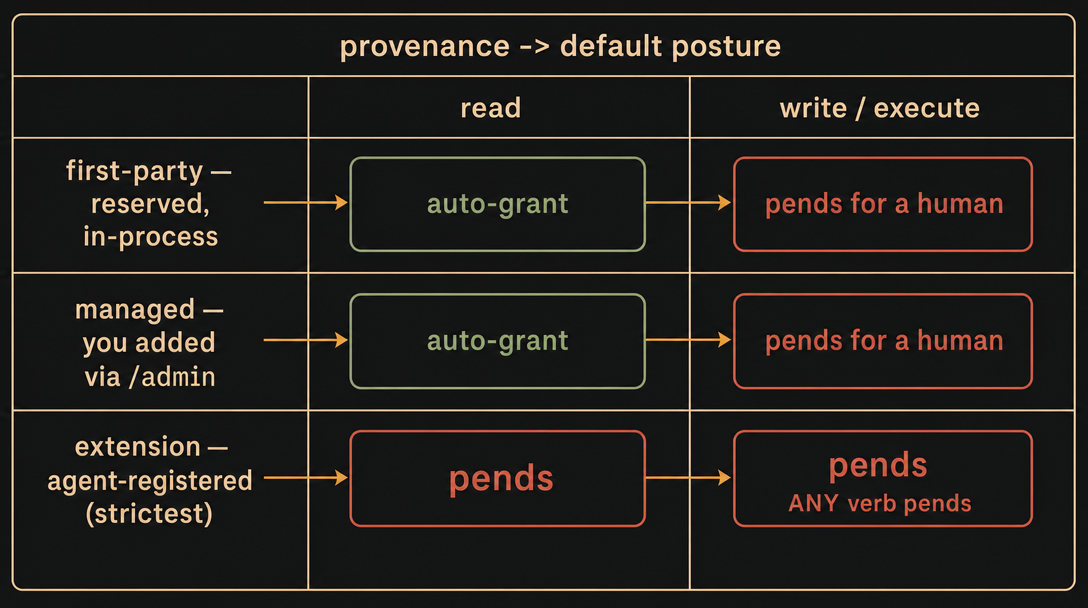
One fact governs how cautious Plexus is with a capability: its provenance — where the capability came from. Trust follows origin.
| Provenance | Means | Default posture |
|---|---|---|
| first-party | A reserved, in-process source (Apple Calendar/Reminders/Notes/Mail/Contacts/Photos, Claude Code, Codex, Shortcuts, browser, browser-control, workspace, sysinfo). | Read flows easily; write/execute still asks a human. |
| managed | A source you added through the trusted /admin UI (e.g. an Obsidian vault — REST or filesystem). Human-vetted at add-time. | Shares first-party read posture; write/exec still pends for a human. |
| extension | Wire-registered by an agent via POST /extensions. The strictest class. | Any verb pends for a human. |
A first-party calendar read and an agent-registered shell wrapper are not the same risk, and Plexus never pretends they are. The gateway stamps provenance from the source — an extension cannot impersonate a first-party id (those ids are reserved).
Sensitivity — the derived risk tier
From provenance + verb + transport, the gateway computes a sensitivity tier, purely for honest narration (so the UI and every agent describe the same risk):
- low — read on first-party / managed.
- elevated — write/exec on first-party / managed, or read on an extension.
- high — write/exec on an extension, or any
cli/local-resttransport with write/exec.
Workflows roll up their members' sensitivity (the max wins).
Standing-eligibility follows sensitivity, not origin (ADR-5)
Not every window is available for every capability. Whether a grant can be standing by default is decided by the capability's own sensitivity — derived from provenance × verb — never by where it came from:
- A
readcapability can be standing: once approved it takes a real window (first-party/managed default7d;writedefaults to1d), so subsequent in-scope reads are frictionless until the window ends or you revoke. - An
execute(or otherwise high-sensitivity) capability defaults to per-use approval, capped atonce— a floor no window the agent requests can lift. Running code (claudecode.run,codex.run) warrants a fresh human decision every time by default. The owner may opt a specific agent + capability pair into standing execute at connect time (default off, double-confirmed); once opted in, the grant rides a real window oruntil-revoked.
Execute is per-use by default — only the owner can lift it
The once ceiling on execute holds under any window the agent requests — the agent can never lift it itself. Lifting it is a deliberate owner act: an explicit per-agent, per-capability opt-in at connect time, default off and double-confirmed. Absent that opt-in, an execute capability stays per-use even under an admin-supplied trust-window; with it, the grant stands until the window ends or you revoke.
Two more owner-side layers compose with the ceiling. Real launch is a machine-level setting on the exec sources (console: What I expose → the source → "Real launch"; audited on every flip): approving an execute call authorizes it, but whether it really spawns the tool — spending your model quota — or performs the honest record-mode dry-run is your machine's own switch, record-mode by default. And exec results are wire-redacted: the calling agent gets ok / launched / sandboxed / output / exitCode; the confinement diagnostics (jail path, machine layout, sandbox argv) appear only in your audit record.
The exposure gate — the owner's outer toggle
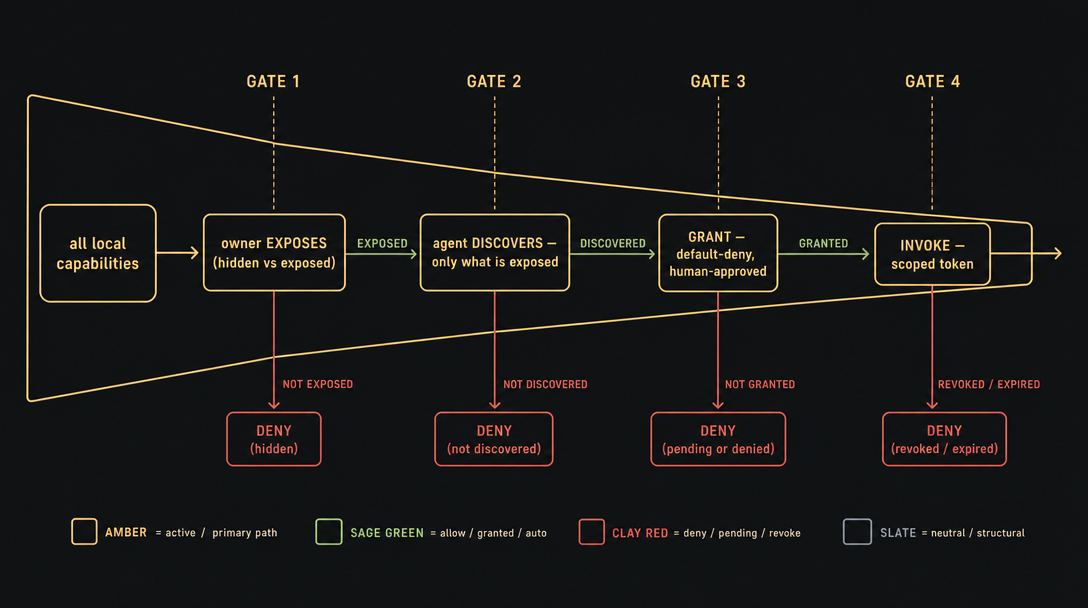
Grants decide what an agent may call; exposure (what-I-expose) is the owner's outer gate sitting in front of them. A capability the owner disables is invisible in discovery, not grantable, and denied at invoke with capability_unexposed — enforced before the grant check. So effective access = granted ∧ exposed: revoking exposure cuts off a capability no matter what standing grants exist.
Visible, revocable, honestly narrated
Standing grants are first-class and visible from both sides: the owner sees them in the /admin Grants tab; the agent sees its own at GET /grants. Each row carries the agent, the capability, the verbs, the provenance, sensitivity, the trust-window, and the expiry.
- Revoke at any time. A human revokes from the Grants tab or via
POST /grants/revokewith the connection-key — byjti, by(agentId, capabilityId), or bybundleIdfor a whole task bundle. An agent may relinquish its own token by presenting that token and itsjti. - Narration is gateway-authored, never agent prose. The risk summary the human approves is written by the gateway. The agent's optional "why now" purpose is shown labeled "the agent says:", is sanitized and truncated, and influences no decision. The agent can never spoof the risk summary.
- Everything is audited. Every handshake, grant, token, invoke, and revoke — including pre-dispatch denials — is recorded to an append-only local audit trail (
GET /admin/api/audit), secrets redacted. Treat it as best-effort observability, not a tamper-evident ledger.
Behind these mechanics sit two instruments a human reasons with: the badge — the agent's durable identity, the per-agent PAT — and the ticket — a task-scoped consent, approved up front and revocable as one act. The task bundle is the ticket's 1.0 form; where it goes next is locked as seams in authorization extensibility (ADR-020).
Where to go next
- Read this once — the full mental model this page zooms into.
- The compile model — how the launcher hides the enroll → handshake → grant → invoke chain while the gateway enforces authz live.
- The security model — the two credentials, the threat model, and what Plexus does not protect against.