
Plexus protocol — M0 contract specification
Status
M0 contract v0.1.4 · Protocol family 0.1 (the major.minor config.ts exports — additive, patch-compatible) · exact version 0.1.4 · Canonical constant: PLEXUS_PROTOCOL_VERSION = "0.1.4" (see VERSION). The wire advertises the family "0.1" (a 0.1.x client interoperates across patch bumps); 0.1.4 is the exact contract revision.
Two credentials + execute-defaults-to-once (ADR-4 / ADR-5 / ADR-023 — the shipped auth model): an agent authenticates with its own durable per-agent PAT (plx_agent_…), redeemed once from a one-time enrollment code (plx_enroll_…); the connection-key (plx_live_…) is the admin/management credential only and agents never see it. The agent loop gains an ENROLL step (POST /agents/enroll) and handshake is PAT-gated for agents. ADR-5 / ADR-023: an execute (high-sensitivity) capability is approved per-use (once) by default — the agent can never lift that itself, under any requested or admin trust-window; the owner may opt a specific (agent, capability) pair into a standing execute grant at connect (default OFF, double-confirmed), and only then does it ride a real trust-window / until-revoked. The authoritative model is the security model; this doc is the wire contract that conforms to it.
This is the core asset: the entire Plexus codebase types off the canonical definitions in types.ts. This document is the human-readable contract; types.ts is the machine source of truth. See Decisions for the ADRs.
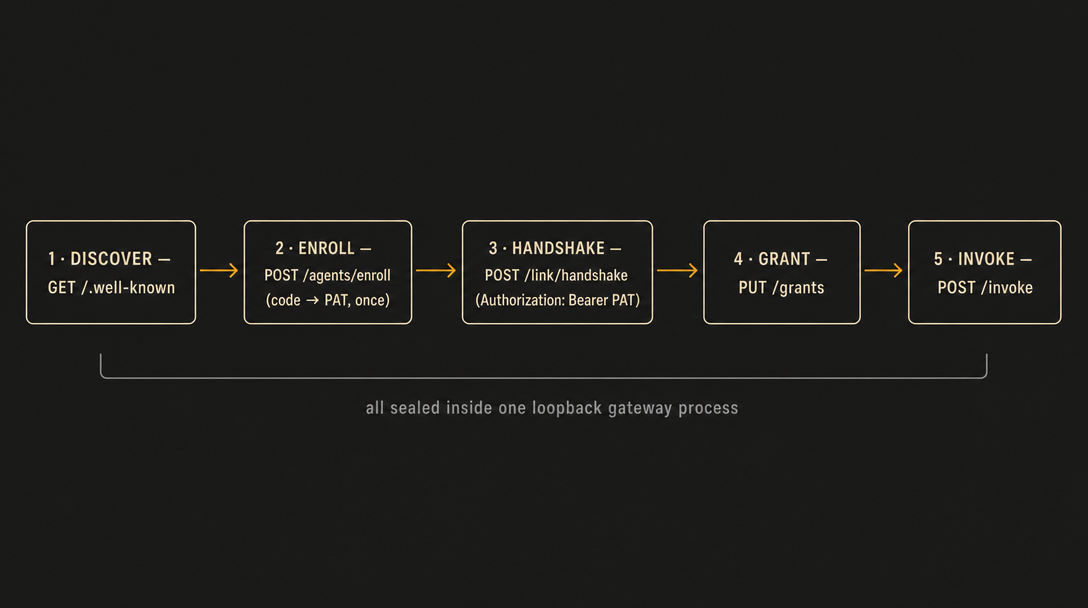
Plexus is a user-installed, open-source local capability gateway. It exposes ONE stable, AI-native self-describe endpoint so any AI agent can DISCOVER → ENROLL → HANDSHAKE → be GRANTED → INVOKE the capabilities of software on the user's machine. An agent enrolls once (redeeming a one-time code for its own durable PAT), then handshakes under that PAT on every session — it never holds the owner's connection-key.
Framing (locked): "MCP = what functions I have; Plexus = how you should use me." MCP is the first-class, privileged ingestion transport (transport: "mcp"); MCP tool/resource/prompt JSON Schemas pass through verbatim. The additive layer — pre-session .well-known self-describe, bundled usage Skills, user-defined extensions, per-capability scoped grants/tokens — lives ABOVE the MCP wire.
Status (MCP ingestion)
The MCP transport/client layer is implemented and tested, but the user-facing "wrap an MCP server as a source" path is not shipped yet — there is no MCP source module in the production registry (MODULES). Today you expose capabilities via first-party sources or by authoring an extension. The MCP design throughout this spec is the locked direction and the transport contract, not an available end-user path (see KNOWN-LIMITATIONS.md).
§7 (read first) — The four Plexus jobs & the data flow
Plexus does four things; everything in this spec serves one of them.
- Scan — probe the machine for installed, adaptable capability sources (first-party adapters, MCP servers, user extensions). Binary/endpoint discovery goes through the platform seam (login-shell PATH capture + fallback candidate dirs, reused from pneuma
path-resolver). - Adapt — each source is fronted by an adapter (
CapabilitySource+CapabilityBridge) that translates its native protocol into the unified entry model. The adapter type is a black box to the core. - Describe — every capability, skill, and workflow registers as one isomorphic self-describe entry (
CapabilityEntry), discriminated bykind. This is the heart: the agent reads "cards" and knows what/how. - Expose — one loopback endpoint surface (
.well-known→ handshake → grants → invoke). Who's behind it is hidden.
 Your desktop                Plexus (local 127.0.0.1 process)              AI agent client
 ┌──────────────┐     ┌───────────────────────────────────────────┐     ┌──────────────────┐
 │ Desktop app  │     │  ADAPTER LAYER            CORE             │     │ Any agent that   │
 │ (local-rest) │──┐  │ ┌─────────────────┐   ┌────────────────┐  │     │ speaks the       │
 │ MCP server   │──┼─▶│ │ CapabilitySource │   │  Registry       │  │  GET │ Plexus protocol  │
 │ (transport:  │  │  │ │  · checkReqs     │──▶│  (entries by id)│◀─┼──────│ 1 DISCOVER       │
 │   mcp)       │  │  │ │  · scan()        │   │                │  │ POST │ /.well-known     │
 │ CLI agent    │──┤  │ └─────────────────┘   │  Enroll ledger  │◀─┼──────│ 2 ENROLL  (code) │
 │ (cli/stdio)  │  │  │ ┌─────────────────┐   │  Grants + Token │  │ POST │ /agents/enroll   │
 │ User ext     │──┘  │ │ CapabilityBridge │   │  store          │◀─┼──────│ 3 HANDSHAKE(PAT) │
 │ (any wire)   │     │ │  · invoke()/route│   │  Audit log      │  │  PUT │ /link/handshake  │
 └──────────────┘     │ │                 │◀──│  (per-session)  │◀─┼──────│ 4 GRANTED        │
   ▲ Transport seam   │ └────────┬────────┘   └────────┬───────┘  │ POST │ /grants          │
   │ Platform seam    │          │ Transport.dispatch() │ Expose  │◀─────│ 5 INVOKE         │
   │                  │          ▼                      ▼          │      │ /invoke          │
   └──────────────────│   local-rest│stdio│ipc│mcp│cli  one URL   │     └──────────────────┘
                      └───────────────────────────────────────────┘
                         Platform seam (macOS first): binary discovery,
                         process spawn, local-service location — all OS-specific
                         parts isolated behind PlatformServices.
Key invariant: the client only ever talks to one stable endpoint surface. Scan / adapt / protocol-translation are all sealed inside the Plexus process — both an engineering decoupling and a compliance boundary. (The diagram shows the five-step agent loop; ENROLL runs once per agent — every later session starts at HANDSHAKE with the stored PAT. The full endpoint set adds the lifecycle endpoints /grants/refresh, /grants/revoke, /grants/status, /manifest, /events, /extensions — all advertised in .well-known, see §2.)
§1 — The unified self-describe entry model
capability / skill / workflow are isomorphic entries discriminated by a kind field, so an agent discovers all three with ONE loop, grants them on ONE surface, and (for capability/workflow) invokes them via ONE path.
Canonical type: CapabilityEntry (alias SelfDescribeEntry) in types.ts.
| Field | Meaning |
|---|---|
id | Globally-unique, stable id. Unit of grant/scope/audit/invocation. Convention <source>.<noun>.<verb>. |
source | The source/adapter that produced it. |
kind | capability | skill | workflow. |
label | Short human label. |
describe | The heart. Semantic, agent-facing "what / when / how to use me well." Convention: "Action outcome. Use when X." |
io | { input?, output? } JSON Schemas. MCP tool schemas drop in verbatim. |
grants | Verbs required: read | write | execute. |
transport | How the adapter reaches the software (see §3). |
skills | Attached usage-Skill refs (the additive "how to use" layer). |
members | (workflow only) ordered WorkflowMember[] ({id, verbs}); each id MUST be a present registry entry. Drives transitive grants (§4). |
body | (skill only) the markdown usage guidance, inline or by ref. |
mcp | (mcp only) verbatim MCP provenance — serverId, protocolVersion, primitive, originName, and raw (the untouched original MCP object). |
version, extras | metadata; extras is never read by core routing. |
The three kinds
capability— a directly callable function or data access. The leaf unit. An ingested MCP tool projects to exactly this.skill— agent-facing usage knowledge ("how to use me well": worked examples, gotchas, conventions). This is the layer MCP does not have. Discoverable, but read-as-context (itstransportis"skill", not invoked).workflow— a user/first-party orchestration of multiple capabilities, exposed as ONE higher-level capability. Invoked like a capability; internally fans out acrossmembers.
How an ingested MCP tool maps onto an entry
Status
Transport/client layer exists and is tested; the user-facing "wrap an MCP server as a source" path is not shipped yet (no MCP source module in the production registry). The projection below is the contract this transport will use (see KNOWN-LIMITATIONS.md).
Plexus runs an MCP client against each MCP source during scan() and projects each primitive to a CapabilityEntry. The shipped client speaks the legacy stateful flow (initialize → tools/list → resources/list → prompts/list); MCP 2026-07-28+ servers drop the handshake for self-contained requests plus an optional server/discover RPC — the projection below is revision-agnostic either way:
| MCP | → Plexus entry field |
|---|---|
Tool name | mcp.originName (and seeds id as mcp.<server>.<name>) |
Tool description | seeds describe (may be enriched by an attached skill) |
Tool inputSchema | io.input VERBATIM |
Tool outputSchema | io.output VERBATIM |
Tool annotations (readOnlyHint etc.) | informs grants (read vs write) |
| The whole Tool JSON | mcp.raw (untouched, for re-projection + façade) |
| Resource | kind:"capability", mcp.primitive:"resource", read-only; mcp.originName = the resource URI |
| Prompt | kind:"skill" or capability seed, mcp.primitive:"prompt"; mcp.originName = the prompt name |
Resources & prompts are first-class (review #1/#2). The mcp transport is not tools-only: it branches on mcp.primitive — a tool dispatches via tools/call, a resource via resources/read (param uri), a prompt via prompts/get (param name + args). Each returns its native shape into the verbatim McpResult slot on the response: content[]+structuredContent (+isError) for tools, contents[] for resources, messages[] for prompts. Every primitive round-trips losslessly (this replaces the old tool-only mcpContent). */list is paged to exhaustion so large servers aren't truncated.
Plexus only wraps; it never rewrites an ingested schema. See the worked example mcp-tool-passthrough.github.create_issue.json.
Schema-validation note (review #10)
"Verbatim passthrough" means the JSON Schema rides through to the manifest/agent unchanged — it does NOT mean /invoke fully enforces it. Runtime invoke does lightweight validation only: required keys present + each top-level property's primitive type + opt-in additionalProperties rejection. Nested objects, $ref, format, and union schemas are not enforced at invoke; the verbatim schema is agent/manifest guidance, not a full JSON-Schema invoke gate.
How a user extension produces the SAME shape
A user extension declares an ExtensionManifest (types.ts §1b) listing the capabilities it contributes; the gateway materializes a CapabilitySource whose scan() projects each declaration into the identical CapabilityEntry shape (the "one sentence to open an Obsidian vault" flow generates one). Registration via POST /extensions (§2) makes Flow B demoable end-to-end. The agent cannot tell — and must not need to tell — a first-party adapter, an ingested MCP tool, and a user extension apart: all three are just entries. Customization is extension; extension is auto-discovered. Local-service credentials (e.g. the Obsidian Local REST API bearer key) are declared as an ExtensionSecretRef and resolved at dispatch time via the platform seam (PlatformServices.resolveSecret) from ~/.plexus/secrets/ — never carried in the entry, manifest, .well-known, or audit. See extension-manifest.obsidian.json.
Worked examples: obsidian.vault.read.json (a user extension, kind:"capability", transport:"local-rest", read-only) and orchestrator.pipeline.run.json (a first-party orchestration, kind:"workflow", transport:"workflow", grants:["execute"], with members).
§2 — Endpoint contract
All endpoints are served on the loopback bind (default http://127.0.0.1:7077); binding a chosen NIC or 0.0.0.0 is an opt-in via ~/.plexus/network.json, with the connection-key as the LAN trust boundary (see §5). Errors use the uniform ErrorResponse envelope.
GET /.well-known/plexus → discovery (unauthenticated, pre-identity)
The unauthenticated front door. It answers "how do I become authorized?" — never "what is here": gateway identity, the auth advertisement (every lifecycle/auth endpoint URL + the enrollment self-description), and a capabilitiesVia pointer — enroll and handshake to receive the list of capabilities Plexus has authorized you to access. The catalog is the product of authorization: the per-agent capability list (the owner-authorized subset, with full schemas and skill bodies) arrives at handshake as the manifest, and an agent never learns Plexus has more. This is also the durable contrast with MCP: MCP discovery (server/discover and the .well-known/mcp.json server card, as of MCP 2026-07-28) answers what functions a server has; Plexus discovery answers how an agent earns an authorized view, and deliberately broadcasts nothing else.
Response (example):
{
  "gateway": {
    "name": "plexus", "version": "0.1.0", "protocol": "0.1",
    "baseUrl": "http://127.0.0.1:7077", "instance": "ez-macbook"
  },
  "capabilitiesVia": "Enroll and handshake to receive the list of capabilities Plexus has authorized you to access.",
  "auth": {
    "enrollmentUrl": "http://127.0.0.1:7077/agents/enroll",
    "enrollment": {
      "url": "http://127.0.0.1:7077/agents/enroll",
      "method": "POST",
      "auth": "body.code",
      "body": { "code": "<one-time enrollment code (plx_enroll_…, delivered out of band)>" },
      "success": { "pat": "<durable bearer PAT (plx_agent_…) — store it yourself>", "agentId": "<your agentId>" },
      "patStorage": "Store the returned PAT yourself (it is returned exactly ONCE), then present it as Authorization: Bearer plx_agent_… at handshake. Enrollment happens once; the stored PAT authenticates every later session."
    },
    "handshakeUrl": "http://127.0.0.1:7077/link/handshake",
    "grantsUrl": "http://127.0.0.1:7077/grants",
    "grantRequestUrl": "http://127.0.0.1:7077/grants",
    "grantRequestMethod": "PUT",
    "sessionHeader": "X-Plexus-Session",
    "refreshUrl": "http://127.0.0.1:7077/grants/refresh",
    "revokeUrl": "http://127.0.0.1:7077/grants/revoke",
    "grantStatusUrl": "http://127.0.0.1:7077/grants/status",
    "invokeUrl": "http://127.0.0.1:7077/invoke",
    "manifestUrl": "http://127.0.0.1:7077/manifest",
    "eventsUrl": "http://127.0.0.1:7077/events",
    "grantsListUrl": "http://127.0.0.1:7077/grants",
    "connectionKeyDelivery": "user-paste",
    "tokenScheme": "plexus-scoped-jwt"
  }
}
The auth block is self-describing: a cold agent that has redeemed its code and stored its PAT reads handshakeUrl (present a Bearer plx_agent_…), grantRequestUrl + grantRequestMethod, and sessionHeader straight from here — it never hard-codes paths or guesses the auth scheme. enrollment describes the one-time code → PAT redeem (below). There is no connectionKey field here; connectionKeyDelivery describes how the owner receives the connection-key out of band (the admin path only, not an agent affordance): the connection-key is the owner's admin credential and is never advertised to, or held by, an agent (§5).
Endpoint-namespace convention (ADR-016)
The agent reads every endpoint URL from this auth advertisement rather than hard-coding paths. The agent-plane endpoints live under the flat namespace /agents/enroll (pre-session, code-gated), /link/handshake (PAT-gated), /grants, /grants/refresh, /grants/revoke, /grants/status, /invoke, /manifest, /events, /extensions. The owner's management plane lives under a separate /admin/api/* namespace, gated by the connection-key — an agent never reaches it (§5).
POST /agents/enroll → redeem a one-time code for a durable PAT (code-gated)
Run once per agent, before the first handshake. The agent presents its one-time enrollment code (plx_enroll_…, single-use, ~15 min) — delivered out of band by the install command the owner handed it (§5). The gateway redeems the code and returns the agent's durable per-agent PAT (plx_agent_…) in plaintext exactly once; it is stored hashed at rest. The agentId is bound by the code server-side — it is not self-asserted.
Request:
{ "code": "plx_enroll_2b7d…c90" }Response:
{ "pat": "plx_agent_9f1a…44e", "agentId": "agent-ez-1" }The agent stores the PAT itself (its own storage, mode 0600), then presents it at every handshake. The code is consumed on success (a replay fails code_consumed). Fail-closed reasons: malformed / unknown_code / code_expired / code_consumed / persist_failed (a durable-write failure leaves the code unconsumed for retry). The connection-key is never accepted here.
POST /link/handshake → the authorized-subset manifest (PAT-gated for agents)
The agent presents its per-agent PAT as Authorization: Bearer plx_agent_… — no connectionKey in the body. The gateway verifies the PAT, resolves the real agentId from it (any client.agentId is metadata only, coerced to the verified id — see §4d), opens a session bound to that id, and returns the agent's authorized-subset manifest: the capabilities the owner authorized for THIS agent (its authorized subset ∩ what is currently exposed, plus any capability covered by an owner-issued standing grant), each entry with full describe, io schemas, grants, transport, attached skill bodies, and MCP passthrough — full detail per entry; catalog coverage scoped to the subset.
Admin path (not the agent path)
The same endpoint also accepts an owner who presents { "connectionKey": "plx_live_…" } in the JSON body (no Bearer) — this is the console's authority and may legitimately name an agentId. The two paths are selected by credential presence and never fall through to each other; an agent has no connection-key to reach the admin path with.
Request (Authorization: Bearer plx_agent_9f1a…44e):
{
  "client": { "name": "claude-code", "version": "2.x" }
}
Response (abridged):
{
  "sessionId": "sess_01J…",
  "expiresAt": "2026-06-23T11:00:00.000Z",
  "grantsUrl": "http://127.0.0.1:7077/grants",
  "manifest": {
    "gateway": { "name": "plexus", "version": "0.1.0", "protocol": "0.1", "baseUrl": "http://127.0.0.1:7077" },
    "sessionId": "sess_01J…",
    "expiresAt": "2026-06-23T11:00:00.000Z",
    "revision": 7,
    "entries": [ /* full CapabilityEntry objects — see examples/*.json */ ]
  }
}
At this point the agent holds no scoped token — it has read-only knowledge, zero call authority. (Default-deny.) manifest.revision is a monotonic counter the agent compares against manifest_changed events to detect a stale view (§2, manifest-refresh).
PUT /grants → scoped-token (per-capability)
The agent (or the user via the management client) selects which entries to allow and at what verbs. Each requested grant is run through the configured Authorizer (the pluggable authorization seam, ADR-007 revised). Returns either a scoped-token covering the approved entries, or a grant_pending_user notice for any grant the policy defers.
Authority note (ADR-007 revised)
The authorize decision is a pluggable abstraction (Authorizer: input = grant request + context → allow | deny | pending). It runs only for requests inside the agent's authorized subset: a scoped agent's request for a capability outside the owner-declared subset is denied before the Authorizer runs (audited, never pended — no owner card), unless an owner-issued standing grant already covers it; the admin-authoritative path (the flow that defines the subset at connect) is exempt. Within the subset: the shipped default is UserConfirmAuthorizer in confirm-risky mode: a read the owner selected at connect is a standing grant and short-circuits — the call goes straight through; any other grant — write / execute, or any grant on an extension-provenance source — PENDS for the owner — returning grant_pending_user. A fully permissive AutoApproveAuthorizer also exists (used by some internal / test flows) and is a drop-in, but it is not the agent-facing default. Both policies speak the same wire — the grant_pending_user + GET /grants/status poll channel is exercised by default for mutating grants, so swapping them needs no wire change.
Request:
{
  "sessionId": "sess_01J…",
  "grants": {
    "obsidian.vault.read": "allow",
    "mcp.github.create_issue": { "decision": "allow", "verbs": ["write"] },
    "orchestrator.pipeline.run": { "decision": "allow", "verbs": ["execute"] }
  }
}
A bare "allow" normalizes to the read-only default. The github entry asks for write explicitly. The orchestrator workflow asks for execute.
Response (approved — note the synthesized transitive member scopes):
{
  "token": "eyJhbGciOiJIUzI1NiIsInR5cCI6IkpXVCJ9.eyJzdWI…",
  "jti": "tok_01J…",
  "expiresAt": "2026-06-23T11:15:00.000Z",
  "scopes": [
    { "id": "obsidian.vault.read", "verbs": ["read"] },
    { "id": "mcp.github.create_issue", "verbs": ["write"] },
    { "id": "orchestrator.pipeline.run", "verbs": ["execute"] },
    { "id": "orchestrator.plan.create", "verbs": ["write"], "synthesizedFor": "orchestrator.pipeline.run" },
    { "id": "orchestrator.task.dispatch", "verbs": ["execute"], "synthesizedFor": "orchestrator.pipeline.run" },
    { "id": "orchestrator.plan.status", "verbs": ["read"], "synthesizedFor": "orchestrator.pipeline.run" }
  ],
  "transitive": [
    {
      "workflowId": "orchestrator.pipeline.run",
      "memberScopes": [
        { "id": "orchestrator.plan.create", "verbs": ["write"] },
        { "id": "orchestrator.task.dispatch", "verbs": ["execute"] },
        { "id": "orchestrator.plan.status", "verbs": ["read"] }
      ]
    }
  ]
}
Transitive grants (review #5, ADR-012): granting the workflow synthesizes member scopes (flagged synthesizedFor) and stamps them into the token, so member dispatch is scope-checked through the same pipeline — no silent escalation. The transitive block is what the management client SURFACES to the user at grant-confirm time ("…which will also run board.create / agent.dispatch / board.status"). Every member id MUST be a present registry entry.
Response (pending — a stricter Authorizer deferred the decision):
{
  "status": "grant_pending_user",
  "pendingId": "pend_01J…",
  "pending": ["orchestrator.pipeline.run"],
  "statusUrl": "http://127.0.0.1:7077/grants/status?pendingId=pend_01J…"
}
The agent then polls GET /grants/status (below) or awaits a grant_resolved event. (The default confirm-risky authorizer emits this for any grant carrying a mutating write / execute verb — the normal path for every non-read capability.)
GET /grants/status?pendingId=… → resolve a pending grant (review #9)
The resolution channel so a grant_pending_user never dead-ends. The agent polls until state is terminal; on "approved" the minted token is included.
Response:
{
  "pendingId": "pend_01J…",
  "state": "approved",
  "capabilities": ["orchestrator.pipeline.run"],
  "token": {
    "token": "eyJ…",
    "jti": "tok_02K…",
    "expiresAt": "2026-06-23T11:30:00.000Z",
    "scopes": [ { "id": "orchestrator.pipeline.run", "verbs": ["execute"] } ]
  }
}
POST /grants/refresh → grant-backed token re-mint (review #4)
Token lifetime is 15 min, locked — but a long-running multi-step workflow can run >24h. Refresh re-mints a fresh 15-min token with the same scopes straight from the persisted grant, bounded by the grant's own validity — no connection-key, no re-prompt. The agent retains only the short token + a refresh handle, never the connection-key. (See the long-running flow in §5.)
Request (Authorization: Bearer <expiring-token>):
{ "sessionId": "sess_01J…", "jti": "tok_01J…" }Response:
{
  "token": "eyJ…newtoken…",
  "jti": "tok_03L…",
  "expiresAt": "2026-06-23T11:30:00.000Z",
  "scopes": [ { "id": "orchestrator.pipeline.run", "verbs": ["execute"] } ],
  "grantExpiresAt": "2026-06-25T10:00:00.000Z"
}
The old jti is revoked; refresh stops working once grantExpiresAt passes (then the agent must re-PUT /grants). Preconditions: session live (§5), grant present
- not revoked, within grant validity.
POST /grants/revoke → revoke a token or grant (review #3)
Driven by the management client's "revoke now" action, or by an agent relinquishing its own token. Two selector forms.
Request (by jti):
{ "jti": "tok_01J…", "reason": "user revoked from management client" }Request (by scope — also removes the persisted grant so refresh can't re-mint):
{ "agentId": "agent-ez-1", "capabilityId": "orchestrator.pipeline.run" }Response:
{ "ok": true, "revokedJtis": ["tok_01J…", "tok_03L…"], "grantRemoved": true, "auditId": "evt_09Z…" }In-flight workflow rule (review #3): the orchestrator re-checks the originating jti's revocation state before EACH member dispatch, so revoking mid-fan-out halts the remaining members (completed dispatches are audited, not undone).
POST /invoke → call a granted capability
The agent calls a capability/workflow, presenting the scoped-token as Authorization: Bearer <token>. The gateway:
- enforces the Host/Origin guard (§5) before anything else;
- verifies the JWT signature + expiry, checks
jtiis not revoked and the session is still live (review #8); - confirms a scope covers
idwith every verb the entry requires — and, when the scope carries aconstraint(ScopeConstraint), that the call'sinputsatisfies it (constraintSatisfied); else the scope is inert and the call is default-denied (grant_required; see §4, content-aware authorization); - validates
inputagainstio.input(lightweight: required keys + top-level primitive types + opt-inadditionalProperties— not full JSON Schema; see the schema-validation note in §1); - routes to the owning
CapabilityBridge→Transport.dispatch()(noif (id===…)— routing is registry/transport-driven); - writes a redacted audit event;
- returns a normalized
InvokeResponse(with the verbatimmcpResultpreserved for MCP-ingested entries — tools/resources/prompts alike).
Request (Authorization: Bearer eyJ…):
{ "id": "obsidian.vault.read", "input": { "query": "Plexus protocol decisions", "limit": 5 } }Response:
{
  "id": "obsidian.vault.read",
  "ok": true,
  "output": { "notes": [ { "path": "Projects/Plexus.md", "title": "Plexus", "content": "…" } ] },
  "auditId": "evt_01J…"
}
MCP tool response (transport:"mcp", verbatim mcpResult):
{
  "id": "mcp.github.create_issue",
  "ok": true,
  "mcpResult": {
    "content": [ { "type": "text", "text": "Created issue #42" } ],
    "structuredContent": { "number": 42, "url": "https://github.com/…/issues/42" }
  },
  "auditId": "evt_02K…"
}
An MCP server returning isError:true maps to ok:false, error.code:"mcp_tool_error", with the server's content[] preserved in mcpResult.content. A resource read populates mcpResult.contents[]; a prompt get populates mcpResult.messages[].
One result contract on /invoke (v0.1.1 — tp2 / ADR-017)
/invoke ALWAYS returns an InvokeResponse-shaped body — for success AND for every denial, including auth/pre-dispatch ones (no token, grant_required, token_revoked/token_expired, session_expired, unknown_capability, schema_validation_failed). A denial body is:
{
  "id": "orchestrator.pipeline.run",
  "ok": false,
  "error": { "code": "grant_required", "message": "No grant for orchestrator.pipeline.run (execute).",
             "capabilityId": "orchestrator.pipeline.run" },
  "auditId": "evt_03L…"
}
So a naive agent deserializing every /invoke reply as InvokeResponse always reads ok:false on denial — never ok === undefined. error.code is drawn from the closed ErrorCode union (§7) so the agent still branches deterministically (refresh vs. re-grant vs. re-handshake vs. give up). auditId is the audit event id for AUDITED denials (every pipeline pre-dispatch denial is audited), and the empty string "" for EDGE denials that fail before the pipeline audits (no token / malformed token / unparseable body).
The HTTP status still classifies the failure for agents that branch on it:
denial error.code | HTTP status |
|---|---|
grant_required, token_expired, token_revoked, session_expired, grant_pending_user, approval_required | 401 |
host_forbidden, capability_unexposed | 403 |
unknown_capability | 404 |
schema_validation_failed | 422 |
rate_limited | 429 |
source_unavailable, capability_unavailable | 503 |
mcp_tool_error, transport_error (in-band dispatch failures) | 200 |
internal_error (and any unmapped code) | 400 |
Scope of the single shape
This InvokeResponse-only rule is /invoke-only. Every OTHER endpoint keeps the uniform ErrorResponse envelope ({ error:{…} }) on failure (§7). /invoke is special because its success body is already an InvokeResponse, so collapsing its denial path to the same shape gives the agent one contract on the call path it hits most.
Routing note (workflows & MCP)
A kind:"workflow" invoke routes to the WorkflowTransport, which re-enters the uniform invoke pipeline per member via invokeById — the core NEVER branches on kind:"workflow" (review #6, §6). Each member call is itself scope-checked (against the synthesized scopes) + audited. A transport:"mcp" invoke routes to the McpTransport, which branches on mcp.primitive (tools/call / resources/read / prompts/get) and preserves the server's native result verbatim in mcpResult.
Async invoke — the run handle (v0.1.4 — ADR-029)
Call-once-and-wait makes the caller's connection the container for the result. For a capability whose runtime is minutes (a real codex.run / claudecode.run task), any hop that caps request duration — a tunnel, a proxy, the agent's own HTTP timeout — answers the agent while the gateway runs the work to completion and audits it, with nowhere to deliver it. The result is lost, and a retry starts a second real execution.
The fix is opt-in and additive. Send async:true, and a call that clears every gate is accepted rather than awaited — HTTP 202:
{
  "id": "codex.run",
  "ok": true,
  "auditId": "",
  "run": {
    "runId": "run_9f1a…44e",
    "status": "running",
    "statusUrl": "http://127.0.0.1:7077/invoke/status?runId=run_9f1a…44e",
    "startedAt": "2026-08-14T00:41:00.000Z",
    "expiresAt": "2026-08-14T01:41:00.000Z"
  }
}
ok:true means accepted, not finished — the tell is run present and output absent. Entries whose runtime warrants this carry longRunning: true in the manifest; a compiled launcher should set async for them on the agent's behalf.
Discovery carries it, not just this page
auth.requestShapes.invoke.body advertises the async field — its longRunning trigger, what comes back, and where to collect it — and auth.requestShapes.invokeStatus describes the collect leg. That placement is load-bearing: a cold agent forms its request from the machine-readable shape, so a channel documented only in prose is a channel that agent will never send. For the same reason each longRunning capability's describe states how to call before it states the approval wait.
Authorization does not move
The async path runs the SAME pre-dispatch gates in the SAME order and returns their denials inline and audited — byte-identical to the synchronous path's, at the usual status, with no run opened. Only the dispatch is detached, and it audits on completion exactly as a synchronous call does.
An agent may hold at most 8 simultaneously-running invokes (rate_limited beyond it): async must not remove the backpressure that holding a connection per call provided. Run records are in-memory and process-scoped like sessions — the audit record is the durable artifact, the result cache is not. The channel requires a scoped-token invoke; grant-assist (a session with no token) stays synchronous.
GET /invoke/status?runId=… → collect an async invoke's result (v0.1.4 — ADR-029)
Returns the handle plus, once settled, the full InvokeResponse the synchronous call would have returned — including ok:false + error for a dispatch failure, and the same auditId. That is what keeps async a transport choice rather than a second result contract.
The handle is a locator, not a credential. Holding a runId authorizes nothing; authorization is re-proven on every read, and accepts only the owner's management connection-key or the same agent the run is bound to (its scoped token or a live X-Plexus-Session).
The binding is the agentId, not the accepting session: a run legitimately outlives its ≤60-minute episode (ADR-028), and binding to the session would strand the agent's own result behind the re-handshake it is required to perform. Both credentials are honored so collection survives the 15-minute token refresh and the 60-minute episode boundary.
Never an existence oracle
A different agent, a bare leaked runId, a revoked token, an invalidated session — all receive a 403 identical to the one an unknown runId receives. A revoke does not abort work already dispatched (no more than it aborts a synchronous call in flight), but it denies the next accept and makes the finished result uncollectable.
The read is idempotent and repeatable until expiresAt — deliberately, since a once-only read would reintroduce the dropped-response loss this channel exists to remove. expiresAt bounds result retention, never the work: a running record is never discarded, and the window is re-stamped from the real completion time when the run settles.
Agents holding a GET /events stream can skip polling: invoke_resolved fires on settle. It carries no output — the notification fans out to every open stream, while the result stays readable only by the agent that made the call.
GET /manifest → refresh the manifest snapshot (review #9)
The handshake manifest is a one-shot snapshot. When the entry set changes mid-session (MCP list_changed, a source coming online, an extension registering), the agent re-fetches its CURRENT authorized-subset manifest WITHOUT re-handshaking. Session- authenticated (e.g. X-Plexus-Session: <sessionId>). Returns { manifest } with a bumped manifest.revision.
Deterministic order + freshness (additive). Manifest entries are always sorted by id — byte-stable serialization across restarts, rescans, and source start-order, which also keeps an agent-side prompt cache valid across re-fetches that changed nothing. Manifest.ttlMs is the freshness hint for pull-only consumers (no events stream): re-fetch after this long. Advisory only — authorization is enforced live, so a stale manifest is never a safety problem; push consumers keep preferring manifest_changed + revision.
GET /grants → standing-grant ledger (ADR-018, v0.1.2, session-authenticated)
The agent's symmetrical view of the user's Grants screen — the caller's standing grants (the durable, human-approved trust, distinct from the 15-min tokens). Session-authenticated exactly like GET /manifest; for a management session it returns ALL standing grants. Advertised via AuthAdvertisement.grantsListUrl. Returns GrantsListResponse { grants: StandingGrant[] } — see §4d for the shape and the trust model. (The admin UI uses the connection-key-gated GET /admin/api/grants.)
GET /events → live event stream (SSE) (review #9)
A Server-Sent Events stream of PlexusEvents so the agent learns of changes without polling:
manifest_changed— re-fetchGET /manifest(carries the newrevision).grant_resolved— a pending grant was decided (carries the token if approved).token_revoked— a held token was revoked; stop using it immediately.source_status— a source's availability changed (diagnostics).
POST /extensions → register a user extension (review #secondary, Flow B)
Registers an ExtensionManifest; the gateway materializes its CapabilitySource, its projected entries enter the registry, and a manifest_changed event fires. Session-authenticated (registration is a user-authorized act).
Request:
{ "sessionId": "sess_01J…", "manifest": { "manifest": "plexus-extension/0.1", "source": "obsidian", "...": "see examples/extension-manifest.obsidian.json" } }Response:
{ "ok": true, "source": "obsidian", "registered": ["obsidian.vault.read"], "revision": 8 }§3 — Transport abstraction
First batch (locked, ADR-003): local-rest | stdio | ipc | mcp | cli, plus two non-wire sentinels skill and workflow. The adapter layer implements the Transport interface per kind; the bridge calls dispatch(). Adding a transport = implement + register; never edit callers.
interface Transport {
  readonly kind: TransportKind;
  dispatch(entry, input, ctx?): Promise<TransportResult>;   // ctx present only for re-entrant transports
}| kind | wire | notes |
|---|---|---|
local-rest | HTTP to a localhost service the app exposes | e.g. Obsidian Local REST API. Endpoint + bearer credential via platform seam. |
stdio | spawn subprocess, NDJSON over stdin/stdout | generic non-MCP stdio adapters. |
ipc | unix socket / named pipe / osascript bridge | OS-specific bits behind platform seam. |
mcp | privileged — Plexus runs an MCP client | branches on mcp.primitive; see below. |
cli | invoke binary with argv, capture stdout (opt. --format json) | binary resolved by path-resolver. |
skill | (none) | sentinel — body delivered as context. |
workflow | (none) | re-enters the invoke pipeline per member; see below. |
The mcp transport, concretely (review #1/#2)
Status
The transport/client layer below is implemented and tested, but no MCP source is registered in production (MODULES) and there is no shipped path to wrap an MCP server as a source yet (see KNOWN-LIMITATIONS.md).
McpTransport extends Transport. Plexus is the MCP client, and dispatch branches on entry.mcp.primitive:
scan():   initialize(serverId)              // clientInfo+caps → server caps; then notifications/initialized
          list(serverId)                    // tools/list + resources/list + prompts/list — PAGED TO EXHAUSTION
          → re-project each primitive to a CapabilityEntry (schemas VERBATIM, mcp.raw kept)
invoke(): primitive "tool"     → call(serverId, originName=tool-name, args)  // tools/call
          primitive "resource" → readResource(serverId, uri=originName)      // resources/read
          primitive "prompt"   → getPrompt(serverId, name=originName, args)  // prompts/get
          → TransportResult { ok, mcpResult: { content?|contents?|messages?, structuredContent?, isError? } }  // VERBATIM
isError:true ⇒ ok:false + error.code:"mcp_tool_error", content[] preserved. A persistent MCP client (owned by CapabilitySource.start()) is reused across request-scoped invokes and re-initialized on session loss. MCP transports run over stdio or Streamable HTTP (/mcp, Mcp-Session-Id header), owned inside the impl. notifications/.../list_changed is surfaced via CapabilitySource.onEntriesChanged → a manifest_changed event to the agent.
The workflow transport, concretely — the orchestrator is "just a transport" (review #6)
There is no external wire. WorkflowTransport.dispatch receives a TransportDispatchContext and re-enters the uniform invoke pipeline for each entry.members[] via invokeById. Consequences:
- The gateway core never has an
if (kind === "workflow")branch — fan-out is ordinary, scope-checked, audited invocation through the same path as any call. - Each member dispatch is checked against the synthesized transitive scopes (§2 grants) carried on the same token — no silent escalation.
- Before EACH member dispatch the pipeline re-checks the originating
jti's revocation state (review #3), so a mid-fan-out revoke halts the rest.
(Chosen over modeling the orchestrator as a first-party CapabilitySource; ADR-013 records why — transport re-entry keeps members on the identical enforcement path.)
§4 — Scoped-token model
Format (ADR-006): signed JWT (HS256, gateway-held secret) + server-side revocation registry. Self-contained to verify (stateless signature check), but every jti is tracked so a grant can be revoked before expiry. Opaque to the agent — it just presents the compact Bearer string.
- Scope shape:
scopes: { id, verbs[], synthesizedFor?, constraint? }[]. Token authority = exactly this union. A call is allowed only if a scope covers the entry'sidwith EVERY verb the entry requires. Default minimal + read-only (a bare"allow"grants["read"]). AsynthesizedForscope is a workflow's transitive member scope (§2). - Content-aware authorization (AUTHZ-UX §3.1): authorization is not merely per-capability + per-verb: a scope/grant may carry an optional
constraint(ScopeConstraint) that only NARROWS coverage — a scope covers a call only when the call'sinputsatisfies it (constraintSatisfied); outside it the scope is inert and the call is default-denied (grant_required). The enforced constraint rides in the signed JWTscopesand is checked at the SAMEPOST /invokechokepoint every call already passes (step 3 below) — it comes from the verified token, never the request body, and FAILS CLOSED on a missing/malformed input field or an unsupported op. Absent ⇒ today's whole-capability scope (unchanged). - Lifecycle: 15 min, LOCKED (ADR-006, user decision). Grants persist in the grant store keyed by
(agentId, capabilityId); tokens are cheap, regenerated views. The agent keeps long tasks alive viaPOST /grants/refresh(ADR-011), which re-mints from the persisted grant with no connection-key and no re-prompt, bounded by the grant's own validity. (This is why a 15-min token is workable for a >24h workflow — see §5 long-running flow.) - Revocation (ADR-010):
POST /grants/revokebyjti(single token) or by(agentId, capabilityId)(all tokens carrying that scope + removes the persisted grant so refresh can't re-mint). Revokedjtis are refused at invoke even beforeexp; a workflow re-checks revocation before each member dispatch (review #3). - Session liveness (review #8): invoke also requires the token's
sessionIdto be live. An agent session is bootstrapped under its PAT, so it is decoupled from connection-key rotation and dies only when that agent's PAT is revoked (POST /admin/api/agents/revoke, §5). Connection-key rotation invalidates the admin/key-bootstrapped sessions and enqueues their tokens' jtis for revocation. Liveness failure ⇒session_expired. - Audit linkage:
sub(agent id),jti(token id), andsessionIdthread through everyAuditEvent, so every call traces to a token and an agent.
Error codes (closed union — review #10)
ErrorResponse.error.code and InvokeResponse.error.code draw from a closed ErrorCode union so the agent branches recovery deterministically. Every endpoint returns failures in the uniform ErrorResponse envelope ({ error:{…} }) — except POST /invoke, which since v0.1.1 (tp2 / ADR-017) returns the InvokeResponse shape ({ id, ok:false, error:{…}, auditId }) for ALL denials so it has one result contract (see §2 POST /invoke). The error.code and HTTP status are identical across both framings; only the surrounding body differs.
Self-healing denials (invariant). Every denial is deterministic to recover from: the closed code names the branch, the table below names the sanctioned next step, and every endpoint needed for recovery is read from the .well-known auth advertisement — never hard-coded. Where the sanctioned path needs request-specific state, the body carries it (pendingId/approvalUrl/ grantStatusUrl, unavailableSince, discovery). Terminal declines say so instructively: a grant request naming a capability outside the agent's authorized view — unknown, unexposed, or out-of-subset — is declined via declined: [{id, reason}] with one uniform reason, byte-identical across the three cases, so a probe learns the next sanctioned step and nothing else (no existence oracle).
| code | agent should |
|---|---|
token_expired | POST /grants/refresh (or re-grant), retry |
token_revoked | re-request via PUT /grants |
grant_required | request a grant for the id/verb |
grant_pending_user | poll GET /grants/status / await grant_resolved |
approval_required | invoke-time analog of grant_pending_user — owner approval needed; poll GET /grants/status with the returned pendingId |
session_expired | re-handshake with the stored PAT (grants persist; a fresh episode restores authority silently) |
unknown_capability | manifest likely stale → GET /manifest |
capability_unexposed | the owner disabled the capability at the top level; not callable until re-enabled |
schema_validation_failed | fix input against the entry's io.input |
source_unavailable | source/app not reachable; back off / surface to user |
capability_unavailable | the capability's home (e.g. a mesh workload) is down right now; back off, retry later |
mcp_tool_error | MCP in-band error; inspect preserved mcpResult.content |
transport_error | transport-level failure; retry / surface |
host_forbidden | Host/Origin check failed (§5) |
rate_limited | back off |
internal_error | unexpected gateway fault |
§4d — Unified trust model (ADR-018, v0.1.2, additive)
The grant machinery has always been correct; v0.1.2 names it and surfaces it so a human in the UI, an agent reading the protocol, and a developer reading the API all read the SAME facts. Everything here is ADDITIVE under the frozen wire: new optional fields and one new endpoint. A v0.1.1 client ignores all of it.
Vocabulary glossary (one word per concept, used verbatim everywhere)
| term | meaning |
|---|---|
| agent | The identity a grant is scoped to (agentId), bound server-side by the agent's PAT at handshake — not self-asserted (see "Trust boundary & agentId" below). A stable, PAT-verified agentId lets Plexus remember standing grants across sessions. A session with no verified PAT (anon:*) gets no standing trust and re-asks every session. |
| capability | The callable entry (CapabilityId). |
| scope | One (capability × verbs) line carried by a token (TokenScope). |
| grant | The standing, human-approved permission (agentId, capabilityId, verbs): this agent may use this capability with these verbs until the trust-window ends (StandingGrant). |
| trust-window | How long a grant stands before re-approval is needed — the lifetime of the human's decision (TrustWindow). |
| token | A short-lived (≈15-min) auto-refreshed view of a grant; the thing presented on /invoke (ScopedToken). |
| provenance / source-class | Where the capability came from: first-party / managed / extension (Provenance). |
| sensitivity | Derived risk tier for narration: low / elevated / high (Sensitivity). |
The three clocks
Three distinct lifetimes, named side by side:
| clock | what it bounds | value | who cares |
|---|---|---|---|
| token-lifetime | blast radius of a leaked credential | ~15 min, auto-refreshed (ScopedToken.expiresAt) | security invariant — short on purpose; clamped to [1min, 60min], never per-approval, never agent-choosable |
| session-lifetime | the episode: how long authority flows silently before the PAT must re-appear | ≤ 60 min, in-memory, dead on gateway restart (SESSION_LIFETIME_MS) | containment invariant — /invoke and /grants/refresh both require the token's session to be live (session_expired otherwise), so a leaked token's silent refresh chain is capped by its episode; only the PAT — in a fresh, audited handshake — opens the next one |
| trust-window | how long the human's approval stands before Plexus re-asks | per source-class × verb (below); StandingGrant.expiresAt / ScopedToken.grantExpiresAt | the user-legible truth; narrated by the agent |
Token-lifetime and trust-window are configurable in ~/.plexus/auth-config.json (tokenLifetimeMs clamped to [60000, 3600000]; maxTrustWindowMs caps custom durations at 30 days — the until-revoked sentinel is NOT clamped by it). Session-lifetime is fixed.
The containment ladder. The clocks compose with the credential taxonomy into a chain of custody: PAT (identity, durable) → session (episode, ≤ 1 h) → token (blast radius, ~15 min). Each rung down is shorter-lived and narrower, and possession of a lower rung never re-derives the rung above. The trust-window can be long (until-revoked is legal) precisely because refresh is episode-capped: within a live session, re-minting is silent (no connection-key, no re-prompt); across episodes, the PAT must be presented again and the handshake is audited. A stolen token dies with min(token-lifetime, its episode, the trust-window) — never with the trust-window alone.
Trust boundary & agentId
Plexus has two trust boundaries, held by two different parties:
- The connection-key (
plx_live_…) is the admin/management boundary. The owner-as-admin holds it; it authenticates the/adminconsole and the admin path of handshake. Rotating it revokes everything key-bootstrapped. Agents never see it. - Each agent authenticates with its own per-agent PAT (
plx_agent_…). The PAT is the agent's session-bootstrap secret and its identity: at handshake the gateway resolves the realagentIdfrom the PAT and binds the session to it, overwriting anyclient.agentId(metadata only). A client therefore cannot self-assert another agent's identity — naming an agent without its PAT gets a 401, no session. Per-agent identity is shipped, not deferred.
Because agentId is PAT-verified, standing grants are safely scoped per agent: a leaked PAT rides only that one agent's grants, and revoking one agent (POST /admin/api/agents/revoke) leaves every other agent untouched — unlike a shared key whose rotation cuts everyone off. The admin path may still name an agentId (the console's "connect an agent" does exactly this): that is not a spoof, because holding the connection-key is the admin authority. The remaining deferred hardening is a keypair (proof-of-possession) PAT — v1 uses a bearer PAT.
The 3-class provenance + posture table
Standing-eligibility is decided by sensitivity (provenance × verb), not origin (ADR-5). Default trust-windows below are the read/write/execute ceiling per class:
| provenance | meaning | read posture | write posture | execute posture | default window (read / write / execute) |
|---|---|---|---|---|---|
| first-party | reserved/in-process source (the MODULES roster: apple-*, workspace, claudecode, codex, sysinfo, shortcuts, browser, browser-control) | standing at connect (owner-selected) | pend | pend | 7d / 1d / once |
| managed | source the user added through the trusted admin UI (human-vetted at add-time) | standing at connect (shares first-party read posture) | pend | pend | 7d / 1d / once |
| extension | wire-registered by an agent via POST /extensions (strictest) | pend | pend | pend | 1d / 1d / once |
executedefaults to per-use (ADR-5, relaxed to owner-override by ADR-023). Anyexecutecapability — first-party, managed, or extension — is approved per-use (once) by default, and the agent can never lift that itself: absent the owner opt-in,chooseTrustWindowholds theoncefloor regardless of the requested window and regardless of whether the pick is admin-authoritative. The owner may opt a specific (agent, capability) pair into a standing execute grant at connect time (default OFF, double-confirmed); once opted in, the grant honors the admin's authoritative window or standsuntil-revoked(clamped to7dwhereuntil-revokedis disallowed).- Connect-selected reads are never silent: they land in the standing-grant ledger with their trust-window.
- A standing, unexpired grant for
(agentId, capabilityId)short-circuits the re-ask for any verb it covers. Aoncegrant (standing:false,expiresAt = grantedAt) is single-use and never short-circuits. until-revokedexists (far-future sentinel; only an explicit revoke ends it) but is never a default; custom durations are capped at 30 days.anon:*sessions (no verified PAT) are session-only: never persist a standing (> session) grant under an anonymous id (capped atonce).
New endpoint — GET /grants (session-authenticated)
Returns the caller's standing-grant ledger — the agent's symmetrical view of the user's Grants screen. The endpoint contract (session auth, advertisement, the management-session and admin variants) lives in §2.
GET /grants → GrantsListResponse { grants: StandingGrant[] }StandingGrant = { agentId, capabilityId, verbs[], provenance, sensitivity?, grantedAt, expiresAt, trustWindow, standing, synthesizedFor?, constraint?, bundleId?, topLevelDisabled? } — where expiresAt is the trust-window end (the user-legible truth) and standing:false flags a non-renewable once grant. The durable constraint (ScopeConstraint) is the content-aware narrowing the grant was approved under (so refresh re-mints a token carrying the SAME enforced constraint; absent ⇒ an unconstrained whole-capability grant); bundleId tags a member of a named Mode-2 task bundle (a grouping that confers NO authority beyond its members); topLevelDisabled:true flags a grant whose capability is currently disabled at the "What I expose" top level (the record stands, but the capability is invisible + uninvokable until re-enabled — effective access = granted ∧ exposed).
Additive optional fields (every change is non-breaking)
| type | added optional field(s) | purpose |
|---|---|---|
CapabilityEntry, CapabilitySummary | provenance, sensitivity, recommendedTrustWindow | so an agent can narrate the cost before requesting (omitted ⇒ treat as extension) |
GrantDecision | trustWindow, purpose, constraint | requester-proposed window — advisory on the agent path (may be shortened, never lengthened past the per-class ceiling), authoritative on the admin approve path; purpose is agent free-text WHY (TRANSPARENCY only — influences NO decision; rendered separately as "the agent says:", capped 280 chars); constraint (ScopeConstraint) the content-aware narrowing to attach (NARROWS only; minted onto TokenScope.constraint) |
GrantPendingResponse, GrantStatusResponse | pendingNarration[] | gateway-authored { id, verbs, provenance, sensitivity, defaultTrustWindow, summary, notificationLine? } so every agent relays the SAME truthful one-liner; notificationLine is the ~120-char gateway-authored tray/notification form (web ignores it) |
GrantRequest | bundle | Mode-2 TASK BUNDLE envelope { name, agentId?, context? } — the multi-capability (+constraint) request is treated as ONE named bundle (members share a bundleId, risky members group-pend as one Approve); a bundle adds NO new authority |
StandingGrant | constraint, bundleId, topLevelDisabled | the durable approved-under constraint (re-minted on refresh); the task-bundle tag; the "granted but disabled (invisible)" exposure flag |
TokenScope | constraint | the ENFORCED scope constraint that rides in the signed JWT scopes and is checked at invoke (constraintSatisfied) |
BundleView, GrantContextRef | (new types) | the admin Grants view's bundle projection (GET /admin/api/bundles) and a reference to one piece of in-scope task context (reuses the kind:"skill" mechanism — skill ref or capped inline markdown; no new transport) |
CapabilityEntry, CapabilitySummary | health | the inherited per-source health SNAPSHOT (HEALTH; see below) |
ScopedToken | grantExpiresAt, trustWindow | the trust-window ceiling next to the 15-min expiresAt |
ScopedTokenClaims | gexp | grant/trust-window expiry epoch (diagnostics) |
AuthAdvertisement | grantsListUrl | where to GET /grants |
AuthorizationDecision | provenance, sensitivity, recommendedTrustWindow | structured reason so the service builds pendingNarration without re-deriving |
Health (HEALTH). Capabilities carry health (CapabilityHealth / HealthStatus: ok | degraded | unavailable | unknown) so agents can read availability and degrade gracefully. The snapshot is per-source (derived from a source's optional health() method, or from its checkRequirements() when that is absent — only health() can report degraded), inherited onto every CapabilityEntry.health / CapabilitySummary.health of that source, and stamped from the gateway's short-TTL health cache at serialization time. Advisory only.
Sensitivity derivation (gateway-computed so all surfaces agree): low = read on first-party/managed; elevated = write/exec on first-party/managed OR read on extension; high = write/exec on extension OR any cli/local-rest transport with write/exec. Workflows roll up members' sensitivity (max wins).
§5 — Security model
- Bind: loopback (
127.0.0.1) by default. Binding a chosen NIC or0.0.0.0is opt-in via~/.plexus/network.json; when enabled, EVERY/admin/api/*route is connection-key gated — the connection-key becomes the LAN trust boundary. (The Host/Origin guard below still runs on every endpoint before auth, regardless of bind.) - Host/Origin guard (review #7, ADR-016): loopback bind alone stops neither other local processes nor a DNS-rebinding browser attack (a malicious page resolving a hostname to 127.0.0.1 and POSTing to
/invoke). EVERY endpoint, BEFORE auth, enforcesHostOriginPolicy: theHostheader MUST equal the bound loopback authority (127.0.0.1:<port>/localhost:<port>), andOrigin— when present (browser context) — MUST be inallowedOrigins(default: only the management client's origin; agent CLIs send no Origin). Failure ⇒host_forbidden. .well-knownfingerprint (accepted): the unauthenticated discovery doc exposes the gateway identity/version + the lifecycle/auth endpoint advertisement to any local caller. This is the price of a self-describing front door, and it is bounded to exactly that: the capability list — even summaries — is not enumerable pre-identity (the authorized-subset model supersedes the old ADR-008 summary bound), so a caller can fingerprint that Plexus runs, never what it exposes; capabilities are delivered only through the PAT-gated handshake (an enrolled agent'sBearer plx_agent_…), scoped to that agent's owner-authorized subset.- Two credentials, never conflated:
- Connection-key (
plx_live_…) — the admin/management credential and trust boundary. Generated by the gateway, shown ONLY in the local management client, obtained out of band; it gates/admin/api/*and the admin path of handshake. Agents never see or present it. Rotatable on demand / auto-rotated; rotation invalidates the admin/key-bootstrapped sessions and enqueues their tokens' jtis for revocation (review #8). - Per-agent PAT (
plx_agent_…) — the agent's own durable credential and session-bootstrap secret (NOT call authority). Redeemed once from a one-time enrollment code (plx_enroll_…, ~15 min, single-use) atPOST /agents/enroll, stored0600by the agent, hashed at rest, independently revocable per agent (POST /admin/api/agents/revoke). It authenticates every handshake; a leaked PAT rides only that one agent's grants.
- Connection-key (
- Default-deny, default-read-only: no entry is callable without an explicit grant; a bare allow grants read only;
write/executemust be named. - Pluggable grant authority (ADR-007 revised): the authorize decision is the pluggable
Authorizerseam (allow | deny | pending). The shipped default isUserConfirmAuthorizer(confirm-risky): a read the owner selected at connect is standing and goes straight through;write/executePEND for the owner viagrant_pending_user. A permissiveAutoApproveAuthorizeralso exists (internal / test) and is a drop-in with no wire change. The seam — not a specific UX — is the contract. - Per-capability + session enforcement: every
/invokere-checks scope coverage against the entry's required verbs AND session liveness ANDjtinon-revocation — per-call, not per-session. - Audit log + redaction CONTRACT (review #secondary, ADR-009 amendment): append-only JSONL under
~/.plexus/audit/(daily-rotated). EachAuditEventrecords type,agentId/sub,jti,sessionId,capabilityId,verbs,outcome, anddetail. Redaction is a contract (AuditRedactionPolicy): the single writer scrubs raw callinput, token strings, connection-keys, and resolved secrets fromdetailbefore persisting —forbidRawInputis enforced, not aspirational. Retention default 90 days. Single write path prevents drift. - Local-first state: all gateway state under
~/.plexus/(grants store, audit, source registry, connection-key, secrets under~/.plexus/secrets/resolved via the platform seam); no pointer files in user cwds.
Connecting an agent — the shipped surfaces (admin → agent → call)
The two-credential model is realized by three shipped surfaces plus a compiled agent interface. The admin acts once; the agent runs one command; then it calls capabilities.
- Admin connects an agent — the console wizard, or
POST /admin/api/agents/connect(connection-key gated). It names the agent, declares the selected cap-set as its authorized subset, grants the subset's read capabilities as standing grants (the human approval, done once; a selected write/execute stays per-use — each call pends — unless its per-capabilitystandingopt-in is set), and mints a one-time enrollment code (plx_enroll_…). - Agent runs the ONE-COMMAND install —
GET /integration/:agentIdserves the copy-able install command (management-gated); the self-contained, secret-freeinstall.shit invokes is public. Running it redeems the code atPOST /agents/enroll→ stores the PAT0600→ deletes the code, and lands the compiled Claude Code plugin. - Agent calls capabilities — via its bundled launcher (below).
The agent interface — the compiled plugin + per-agent launcher. The plugin ships a version-isolated launcher plexus-<agentId> that execs its OWN bundled engine (the sibling bin/plexus) and binds PLEXUS_AGENT_ID — never a global plexus, so two agents' plugins can't collide or authenticate as the wrong agent. Subcommands:
plexus-<agentId> enroll <code>       # once, at install: redeem code → store PAT
plexus-<agentId> list                # discover: callable-now vs needs-approval
plexus-<agentId> <capabilityId> …    # invoke a granted capability
The bundled skill is a projection over the always-present self-describing Floor (.well-known + requestShapes + how-to-use); a stale skill can never exceed the Floor's live authz. Load-bearing rule: the launcher command is the agent's complete and only interface — never hand-roll HTTP, never call enroll/handshake/manifest by hand, never guess auth. The engine that performs the enroll → handshake → grant → invoke chain (bin/plexus) is byte-verified against the committed sanctioned engine at build time; no auth path is LLM-authored. (See For agents for the agent-side view.)
Persistence. A registered extension and its projected entries persist across gateway restart — on reboot Plexus trusts the already-persisted config and boots it without re-prompting (a fresh registration still pends a human; §4d exposure/grant records survive too).
Worked flow — a >24h workflow orchestration on a 15-min token
- Agent handshakes,
PUT /grantsfororchestrator.pipeline.run(execute). The token also carries the synthesized member scopes (board.create / agent. dispatch / board.status), surfaced to the user via thetransitiveblock. - Agent
POST /invokes the workflow → theWorkflowTransportfans out to members viainvokeById, each scope-checked + audited, revocation re-checked per member. - The 15-min token nears
exp. The agent callsPOST /grants/refreshwith itsjti+ session → a fresh 15-min token, no connection-key, no re-prompt, bounded bygrantExpiresAt. Repeat across the >24h run. - Mid-run, a source adds capabilities →
manifest_changedSSE event → agentGET /manifestto refresh. If the user revokes from the management client →token_revokedevent + the workflow halts before its next member dispatch.
ADR-5 / ADR-023 caveat
orchestrator.pipeline.run is an execute capability, so its grant is per-use (once) by default — the refresh loop above must not be read as an execute cap riding a standing window on its own. Refresh-for-longevity is the pattern for standing-eligible scopes (read/write within their trust-windows, e.g. the board.status read member); by default the execute approval covers its single sanctioned invocation, and re-invoking the workflow re-prompts the owner. The owner can lift this for a specific agent + capability by opting into a standing execute grant at connect (ADR-023: default OFF, double-confirmed) — only then does an execute grant ride a real trust-window. See §4d and the security model §3.
§6 — Adapter-layer architecture
Two layers, mirroring pneuma-skills. The adapter type is hidden behind these interfaces; the core never branches on source/transport type.
- Lifecycle layer —
CapabilitySource(≈ pneumaAgentBackend+BackendModule):checkRequirements()(cheap availability probe via platform seam),scan()(enumerate/project entries — for MCP this runs the client handshake + list paged to exhaustion + re-project; for a source exposing akind:"workflow"entry,scan()returns the workflow AND its member entries so transitive grants have real targets — review #secondary, Flow A),start()(owns the persistent MCP client for the source lifetime),stop(), optionalonEntriesChanged()(MCPlist_changed), and an optionalinstall()— a first-class, user-confirmed + audited (source.install) action that replaces the oldextras.autoInstallblob the core never read (review #secondary, Flow A). - Per-session protocol-translation layer —
CapabilityBridge(≈ pneumaBridgeBackend): one instance per (session × source), closes over its adapter so the adapter type stays private.getCapabilities(),invoke(req, ctx),route() → "handled" | "unsupported" | "passthrough",disconnect(). The gateway enforces grants BEFORE callinginvoke(); the bridge translates to the transport and normalizes the result, and MUST emit an audit event.BridgeDepsnow carriesaudit(folding the adapter-deps asymmetry — sources can auditsource_unavailable, review #secondary) andinvokeById(the re-entrant pipeline theworkflowtransport fans out through — review #6).
Central registry (no scattered branching)
Each source ships a SourceModule from sources/<id>/manifest.ts. The SourceRegistry is the only place modules are aggregated (≈ pneuma backends/index.ts: MODULES). Every caller goes through registry.get(id) / registry.getTransport(kind) / registry.all() — no if (id === ...) lives outside a source module. Adding a source = write a manifest, add it to the registry map. Done: discovery, availability, scan, invoke routing all flow automatically.
Platform-abstraction seam
Everything OS-specific — binary discovery, process spawn, local-service location, secret resolution — lives behind PlatformServices (resolveBinary, getEnrichedPath, locateLocalService, spawnProcess, resolveSecret). macOS is the primary, end-to-end-validated implementation; Windows and Linux implementations of the same seam ship today, selected at runtime by platform (Linux with a portable first-party source allowlist), with real on-OS end-to-end validation still pending. Reuses pneuma path-resolver (login-shell PATH capture with fallback candidate dirs). Core + adapters depend ONLY on this interface — no process.platform checks leak into the core. resolveSecret is the credential path for local services that require auth (e.g. the Obsidian Local REST API bearer key, review #secondary): secrets live under ~/.plexus/secrets/, referenced by name from an ExtensionSecretRef, handed only to the owning transport at dispatch, never to core / manifest / audit.
Optional later output: MCP-server façade
The contract is shaped so a future MCP-server façade output adapter can re-emit the Plexus subset as a normal MCP server for pure-MCP clients. The mcp.raw field preserves every ingested tool verbatim for exact re-projection; user-extension/workflow entries project DOWN to MCP tools (losing only the additive skill/grant layer MCP can't carry). Designed-for, not built in M0.
Appendix — file map
VERSION— contract version tag (0.1.3).types.ts— canonical TypeScript types (source of truth).examples/obsidian.vault.read.json— user extension, read-only.examples/orchestrator.pipeline.run.json— first-party workflow, execute,WorkflowMember[]members.examples/mcp-tool-passthrough.github.create_issue.json— ingested MCP tool, verbatim passthrough.examples/extension-manifest.obsidian.json— minimal user-extension manifest (Flow B register path).- Decisions — ADRs (M0 v0.1.3).