
The compile model
Plexus doesn't stop at making your tools reachable. It hands each agent "here is exactly how you call these capabilities," compiled into that agent's native idiom and installed. This page is the focused read on how that works. For the whole mental model in context, start with the concepts.
Why this exists
Even a perfectly self-describing surface still makes a cold agent learn a novel protocol on the fly — integrators know MCP and REST; they've rarely seen a well-defined resource that explains how to use itself. The fix isn't a better spec. It's compiling the resource into the agent's native idiom and handing it over installed — so the agent doesn't figure out Plexus, it gets handed a native command.
The Floor — the always-present source of truth
The Floor is the always-present, self-describing resource surface:
GET /.well-known/plexus— the gateway identity +requestShapes+ the auth / enrollment advertisement, plus a pointer: enroll and handshake to receive the capabilities Plexus authorized you to access,- the post-handshake manifest — the agent's owner-authorized capability list, each entry with its
io(JSON-Schema input/output), - attached
how-to-useskills (markdown guidance),
…over plain HTTP (or MCP). It works for any agent with no artifact installed — enroll, handshake, grant, and invoke are all discoverable from it. Nothing an agent needs is hidden behind bespoke tooling. This is the source of truth; everything else is a view over it.
The Floor even self-describes its own bootstrap: .well-known/plexus advertises the auth.enrollment block (the redeem URL/method, body.code, success.pat, the patStorage instruction, the errorCodes), so a skill-less agent can self-enroll from the Floor alone and construct its enroll and handshake calls straight from .well-known — capability calls follow from the manifest the handshake delivers.
The compiled plugin — a projection, never a replacement
On top of the Floor, Plexus compiles a per-agent artifact (v1: a Claude Code plugin) that makes the same capabilities feel native to that specific agent. The artifact is a projection over the Floor — a cache/shortcut, never a replacement.
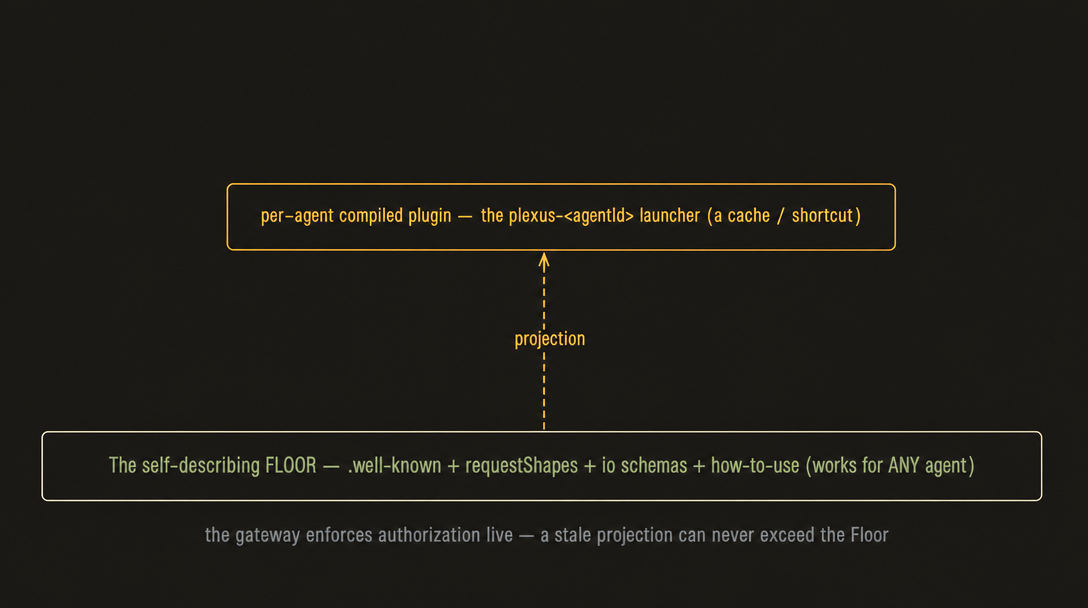
Two invariants keep the projection honest:
- Additive, never replacement. The Floor always works for any agent over any transport. No Claude Code / Codex present → generate nothing, fall back to the Floor.
- Staleness is safe. Because a skill is a projection and the gateway enforces authz live, a stale or mis-generated skill can never exceed the Floor's authority. Worst case is cosmetic: it mentions a revoked capability → the invoke fails at the gateway; or it misses one the owner newly authorized for this agent →
listsurfaces it anyway. Auto-update is therefore a freshness/UX feature, not a safety one.
The plexus-<agentId> launcher
The compiled plugin ships a version-isolated per-agent launcher that hides the entire enroll → PAT → handshake → token → invoke chain — the agent sees only a native command, never the plumbing. It is plexus-<agentId> (its own bundled engine + a baked-in PLEXUS_AGENT_ID), never a bare global plexus, so two agents on one host never collide and each pins its own engine version.
Its subcommands are the agent's entire vocabulary:
plexus-<agentId> enroll <code>— redeem the one-time code → PAT → self-store (first run only).plexus-<agentId> list— the discovery verb: enumerate this agent's capabilities, split into callable-now (standing-granted) vs needs-approval, with skills (usage guidance, read-as-context — never wire-invoked) grouped in their own section. This is how an agent orients before it acts, instead of guessing capability ids — including any capability the owner authorizes for this agent after the plugin was compiled (the Floor is live; the projection just caches it).plexus-<agentId> <capabilityId> [args]— invoke a capability (e.g.plexus-<agentId> obsidian.vault.read Welcome.md). A call that needs approval waits: the launcher blocks on the advertised status endpoint and invokes the moment the owner approves — call once and wait, never retry-loop (--no-waitopts out).plexus-<agentId> <skillId>prints the skill's guidance body.
Three-tier progressive disclosure runs through it: a one-liner always in context → the skill body (guidance, including agent-native key-management advice) → the launcher whose internals never enter the agent's context.
The command is your only interface
A hard rule the compiled skill states outright
Drive every interaction through plexus-<agentId> …. Never hand-roll HTTP against the gateway, never guess an auth header, never try to mint or read a token. The command already encapsulates the sanctioned auth flow; anything else is both unnecessary and an over-reach the gateway will reject.
This directly answers the failure mode a cold agent falls into: faced with a vague error, it tries to forge its own credential or read an on-disk key. With the launcher, there is exactly one advertised forward path — the audited, owner-approved one.
Two guarantees make trusting the command safe:
- The auth/invoke core is templated, never LLM-authored. It is rendered from a deterministic per-agent-type template filled from the Floor's
requestShapes/io— never improvised. (An LLM writing the auth path could ship an over-reach tutorial; so an LLM may write only the pedagogical shell — task-framing, examples — never the mechanics.) - No durable secret is ever baked into the artifact. A build-time verifier (
integration/verify-plugin.ts) checks a rendered plugin against the Floor across five axes: the sanctioned auth core is byte-identical, no secret is baked in, only advertised/granted capabilities are referenced, the sanctioned enroll/handshake/invoke flow is used, and the hand-authored skill prose is hash-pinned — any edit to the pedagogical shell forces a deliberate re-review and re-pin before it ships. Only the short-lived, single-use enrollment code rides the install.
How it fits the credential boundary
The launcher exists because the connection-key is admin-only and each agent authenticates with its own per-agent PAT. Skill generation is an admin-time, admin-host act: it happens in the config/management phase, decoupled from the call path — no live CLI-driving in a Connect flow, no runtime latency at invoke. The blast radius of a leaked artifact is bounded to one agent's pre-granted capabilities, independently revocable — see the trust model and the security model.
Extensions are durable across restarts: an added source/capability is written to ~/.plexus/extensions.json and replayed at boot, so it survives a gateway restart rather than evaporating with process memory.
Where to go next
- Read this once — the full mental model, including the two-tier self-describe protocol this page builds on.
- The trust model — default-deny, the three clocks, and why execute defaults to per-use approval.
- Connect an agent — see the launcher drive a real Claude Code / Codex agent end to end.