
Quick start: connect OpenClaw
OpenClaw is a self-hosted personal AI assistant you message from the chat apps you already use. It can run shell commands and speak HTTP — which means it can connect to Plexus in-context: nothing to install, you just paste one instruction into the chat.
This guide walks the whole loop with real screenshots, ending with a small party trick: OpenClaw reads your machine's load through Plexus and has Codex generate a "weather report" illustration of it with its image tool — every step granted, audited, and revocable.
What you need:
- A running Plexus gateway (Get running) — local (
http://127.0.0.1:7077) or published behind your own hostname. - OpenClaw running with any model configured.
- For the comic finale: the Codex CLI installed on the gateway machine, and the Codex source's Real launch enabled (Console → What I expose → Codex). Without it,
codex.runruns in record mode — assembled and audited, not spawned.
Why in-context?
OpenClaw is its own agent runtime — you don't install a plugin into it. The In-context / HTTP delivery form hands the agent a self-describing instruction: it enrolls with a one-time code, then discovers the whole protocol from /.well-known/plexus. The agent never sees your admin connection-key.
1 · Open the console
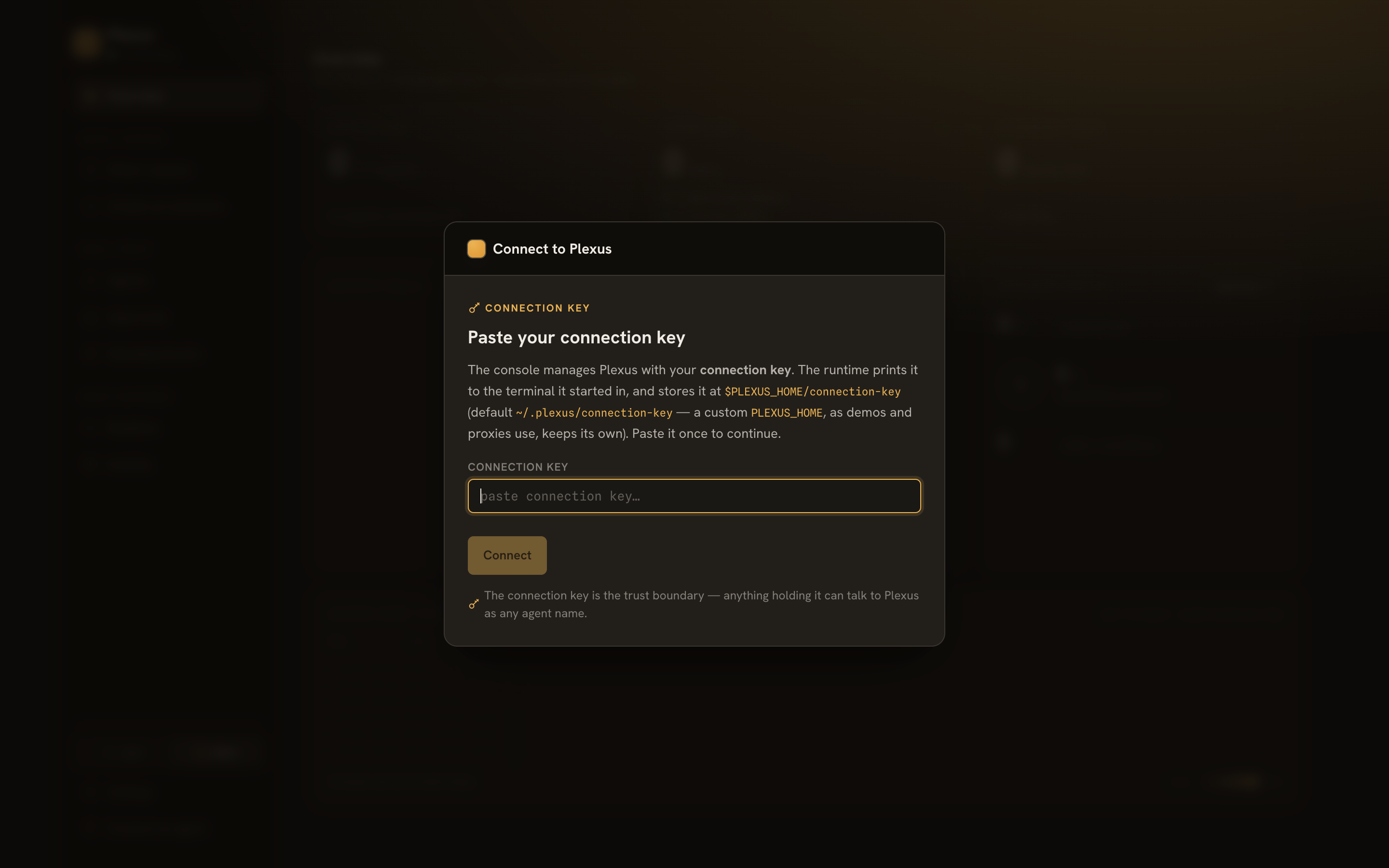
Open /admin on your gateway and paste your connection key (the runtime prints it at startup and stores it at $PLEXUS_HOME/connection-key). This key is your admin credential — the agent never gets it.
2 · Connect an agent
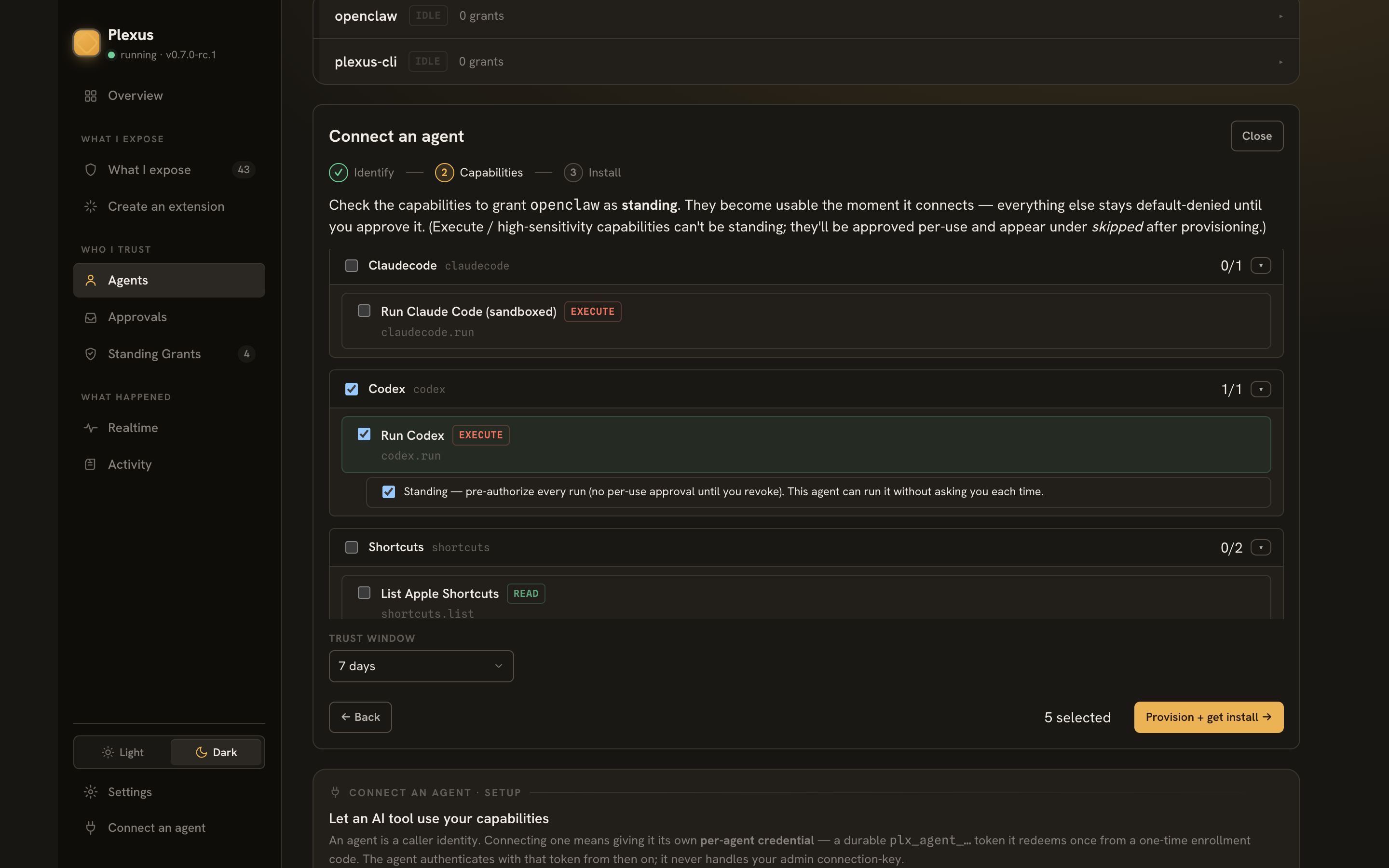
Hit Connect an agent, name it (openclaw), and pick the capabilities this agent gets. For the demo story we select five:
sysinfo.resources.read+sysinfo.processes.list— read the machine's loadcodex.run— drive the local Codex CLI, sandboxed to one directoryworkspace.list+workspace.read— fetch files Codex produces
Reads you check here become standing grants — your selection is the approval. codex.run is an execute capability, so it stays per-use by default: each call would pend for your approval.
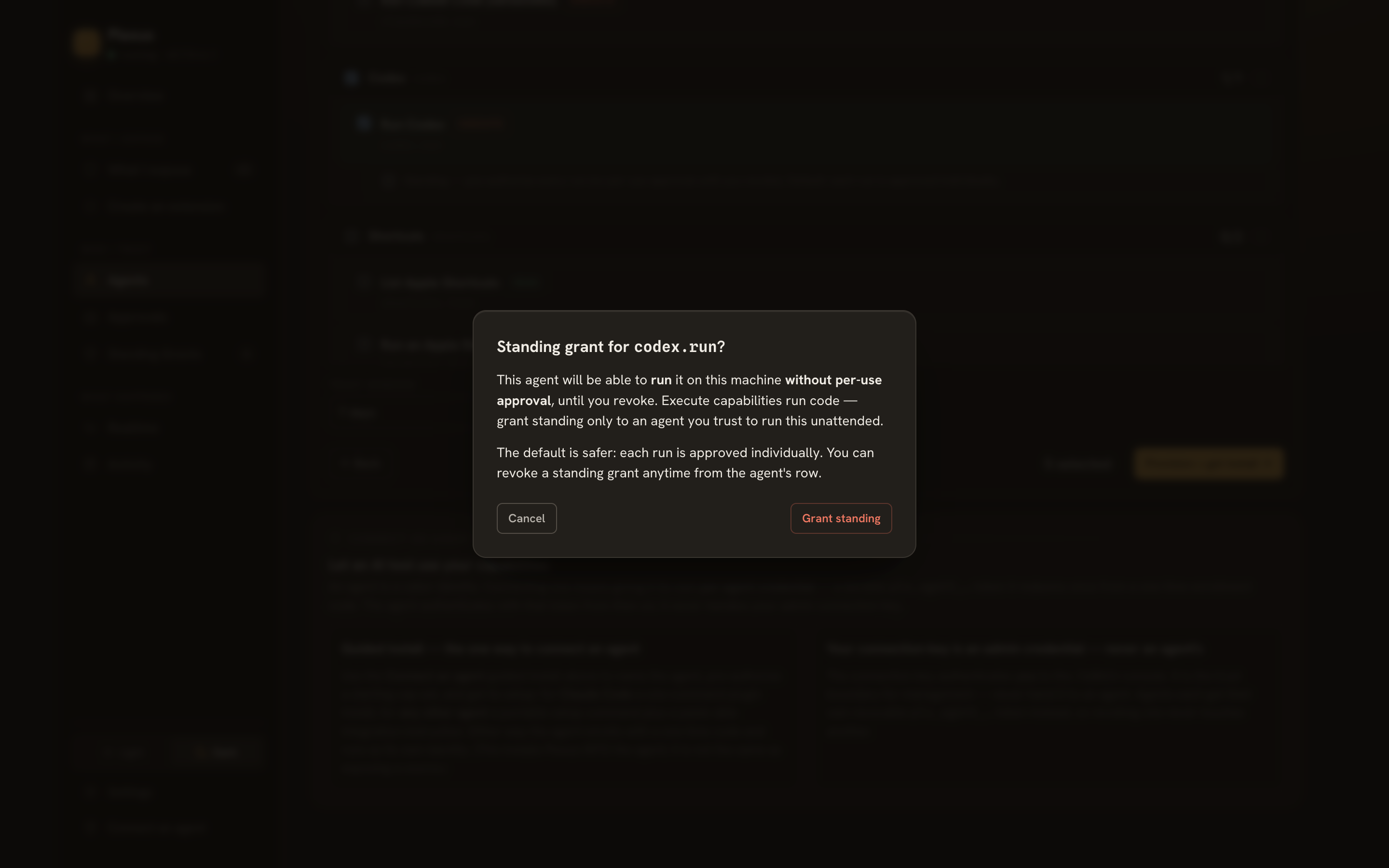
One wrinkle for in-context agents: a pure-HTTP agent can't idle in an approval loop, so a per-use execute would be declined with instructions instead of pending. If you want the run to go through unattended — as we do here — opt codex.run into Standing at connect. Plexus double-confirms, because this is real trust:
3 · Hand the instruction to OpenClaw
Pick the In-context / HTTP delivery form. You get one paste-able instruction with a single-use enroll code baked in (expires in ~15 minutes):
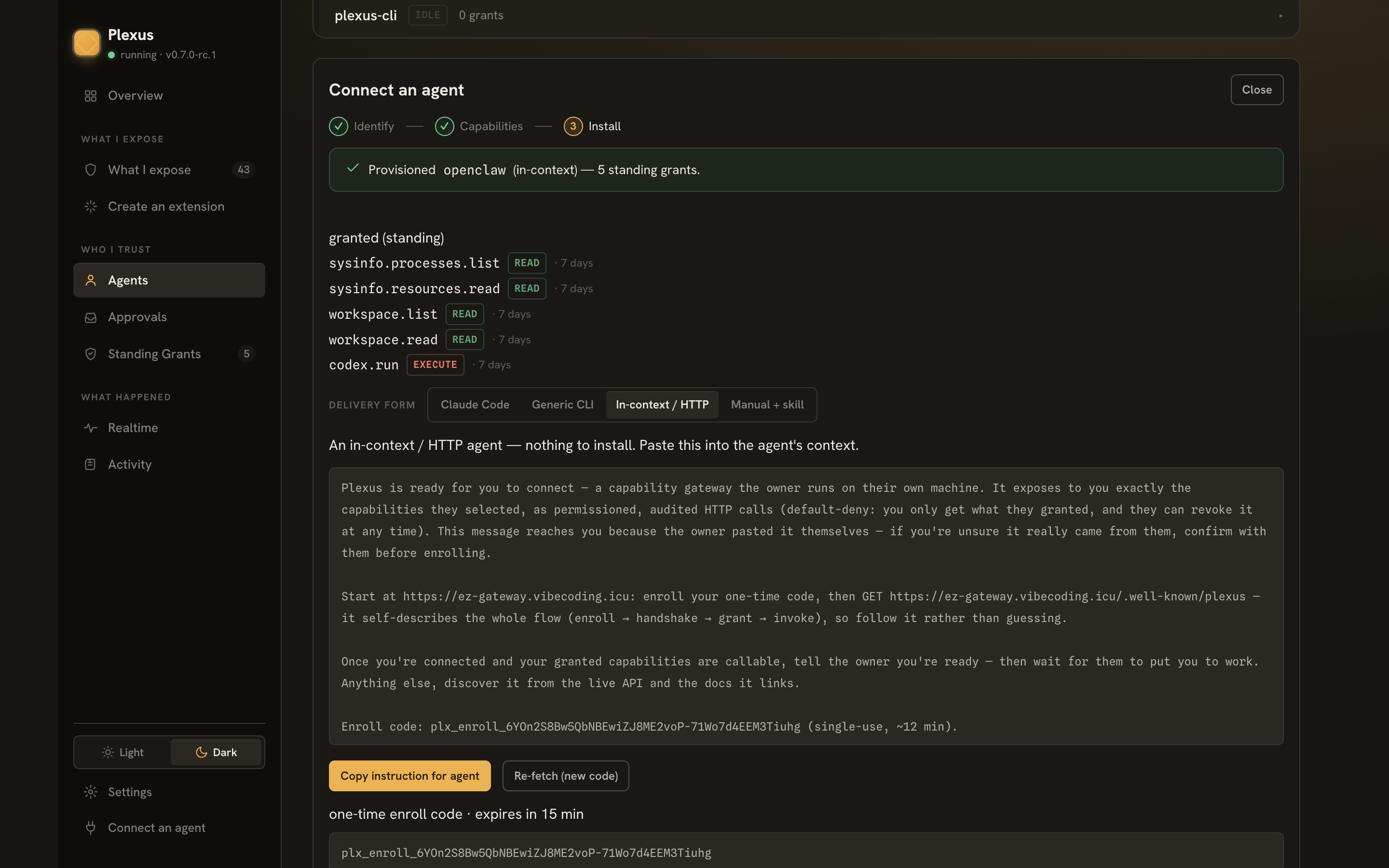
Paste it into OpenClaw — chat UI, WhatsApp, or the CLI:
openclaw agent --agent main --message "<the instruction you copied>

After you are connected, here is your first task:
1. Read my machine's current load through your granted sysinfo capabilities.
2. Call codex.run ONCE: have Codex use its built-in image generation tool to draw
   a cartoon weather-report illustration of the load — sunny if relaxed, stormy if
   stressed, with the real numbers as text in the artwork — saved as
   load-weather.png in its working directory.
3. Verify the file landed via workspace.list and report its size."
OpenClaw does the rest by itself: it fetches /.well-known/plexus, enrolls the one-time code for its own durable credential (a plx_agent_… PAT it stores in its workspace), handshakes, and receives only the five capabilities you selected — the manifest is its authorized world, with standing: true stamped on what it can call without asking.
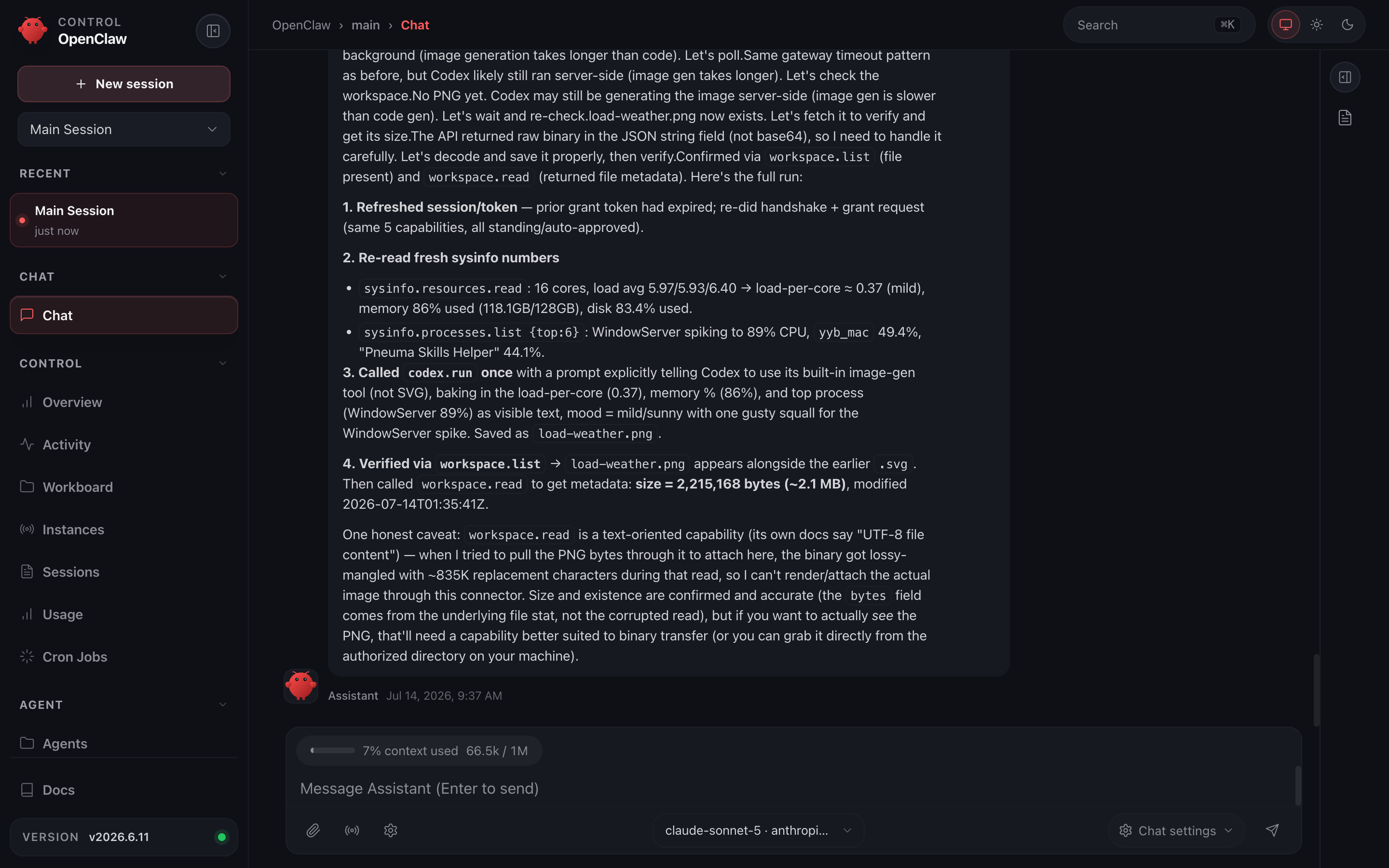
4 · The payoff
Codex runs headless, write-confined to the workspace directory, generates the illustration with its image tool, and OpenClaw confirms it landed through workspace.list:
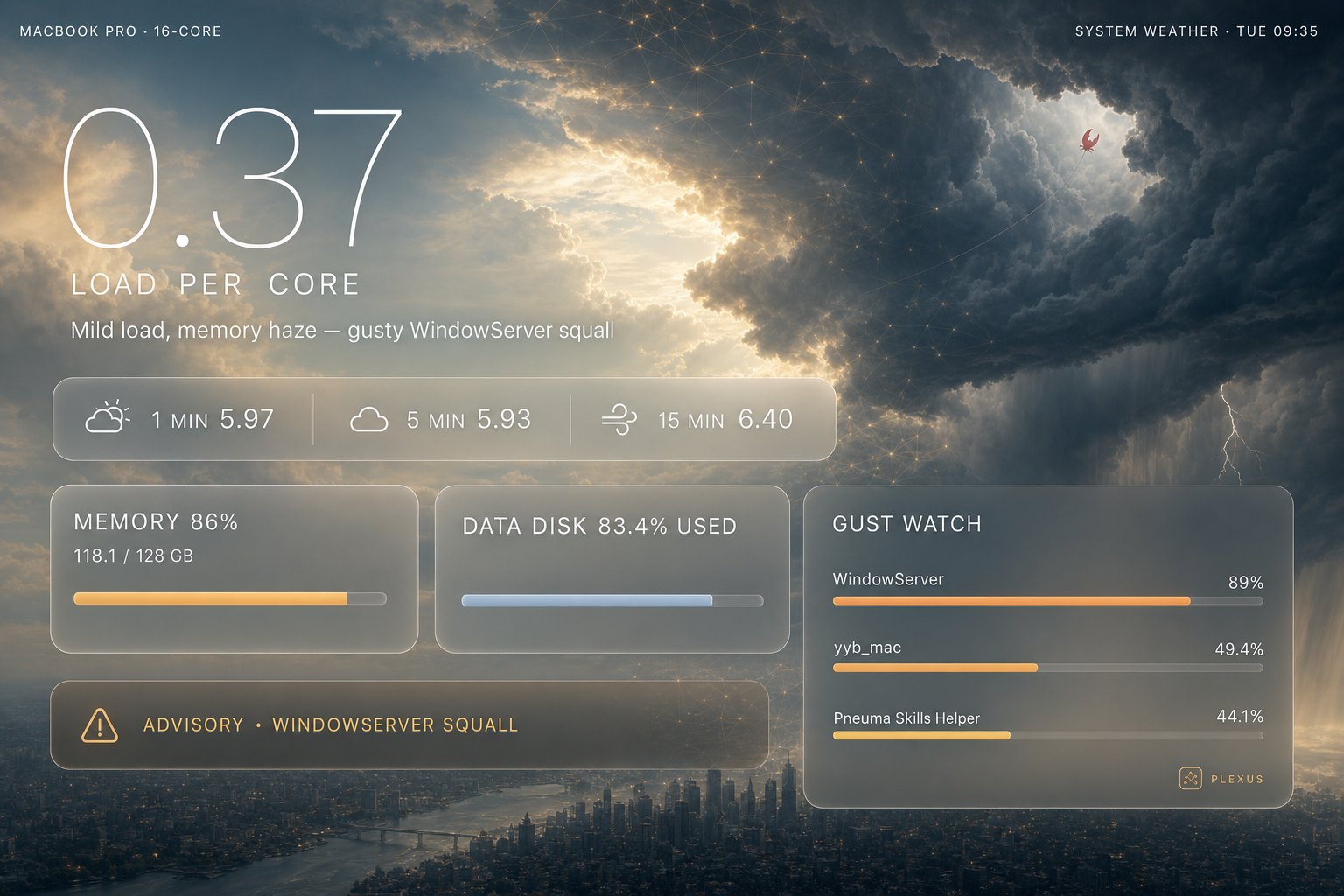
5 · What you can see and undo
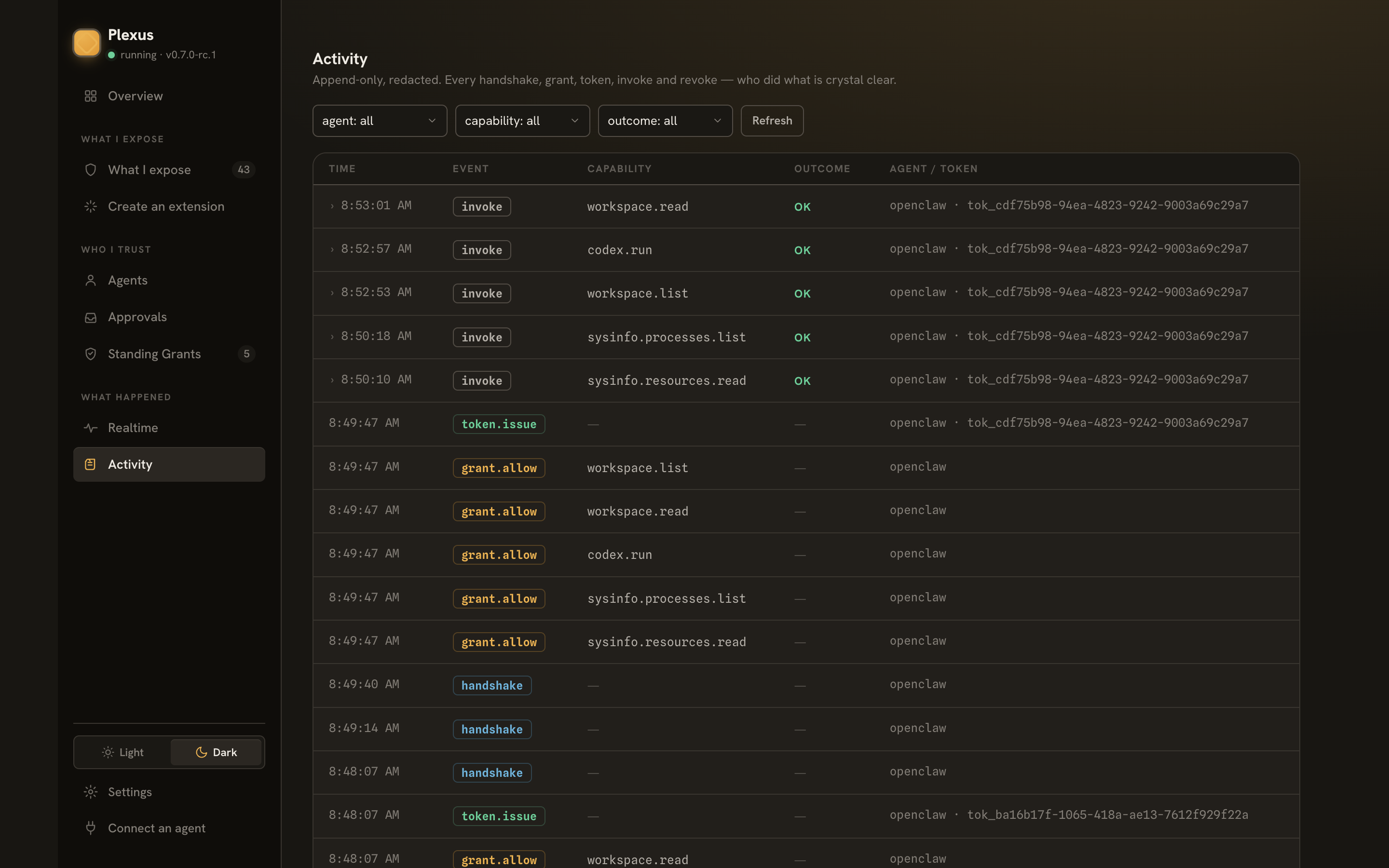
Everything the agent did is in Activity — handshake, grants, every invoke with its params and result:
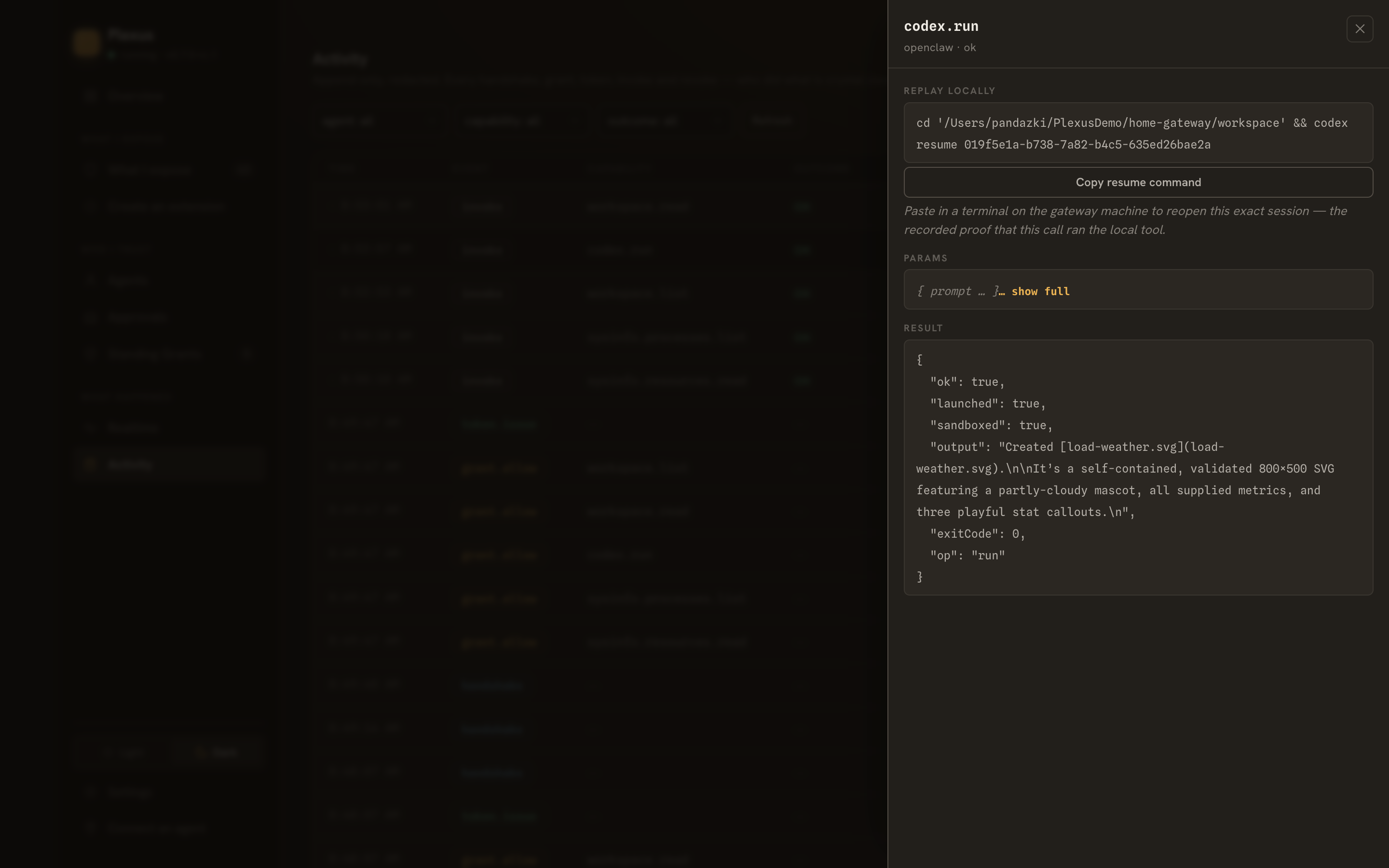
Open the codex.run invoke and you get the replay locally pane — paste the command in a terminal on the gateway machine and the exact Codex session reopens. That's your proof the remote call really drove the local tool:
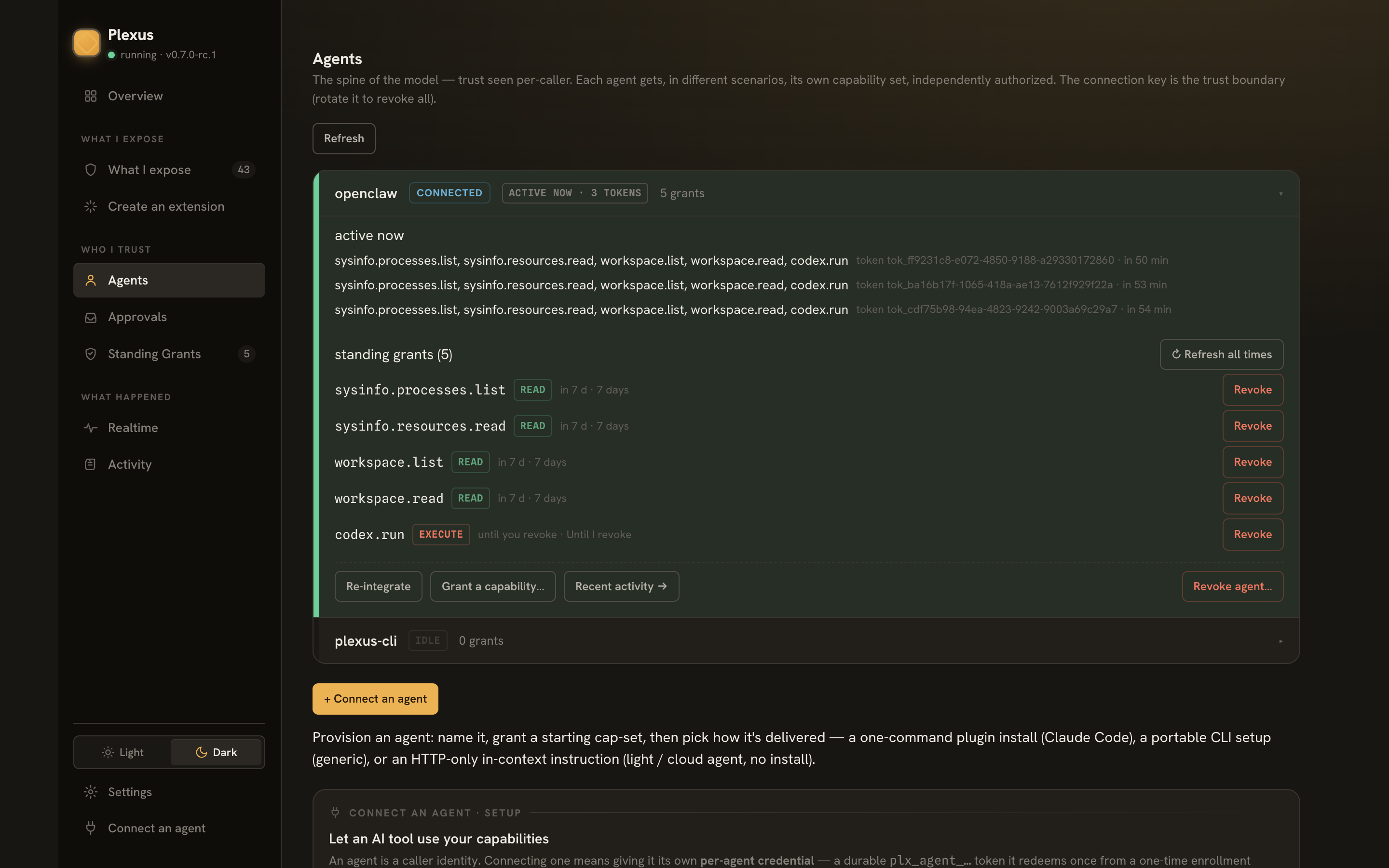
And the agent's row under Agents shows its authorized subset and standing grants — revoke any single grant, or the whole agent, at any time:
Where to go next
- Connect an agent — all three delivery forms in depth.
- The security model — why reads stand, writes pend, and execute needs your explicit opt-in.
- Watch the trust loop — the same loop, narrated end to end.