
The federated mesh — developer model
Status
Implemented (the P1–P5 mesh epic). This is the operator/extender companion to the DDD SSOT federated-mesh-domain-model.md: where that doc defines the language + invariants, this one maps every load-bearing invariant onto the code that enforces it, cites file:line, and tells you where to hook in. When the two disagree, the code wins and this doc notes it (§13).
Code root for everything below: packages/runtime/src/mesh/ unless another path is given.
Mental model in 5 sentences
- A mesh is exactly one
primarygateway (the agent's front door — it holds grants, runs the authorizer, sinks audit) and any number ofproxygateways that live next to real services and dial out a single persistent tunnel to the primary (NAT-forced: no inbound hole on a proxy host). - A proxy enrolls once with a 256-bit one-time join token that the primary minted out-of-band; enrollment pins the proxy's Ed25519 public key into a durable ledger (
enrollments.json) and the token is the anti-replay nonce. - Every reconnect re-proves identity with an Ed25519 mutual challenge over the tunnel; only an authenticated socket is promoted to carry data frames, and the proxy trusts any
invokearriving on that socket as already authorized (the primary is the authority — tunnel-trust). - A proxy advertises bare
source.capabilityids; the primary mounts them undertenant/workload/…to form the stable address (identity), while health/reachability is a mutable route fact — so grants bind to addresses and survive reconnects, downtime, and failover. - An agent
invokeon the primary for a mounted address is forwarded down that workload's tunnel, executed against the bare id, and returned origin-agnostically; if the home is down the caller gets a typedcapability_unavailable(never a hang), and revoking a workload tombstones its enrollment + unmounts + purges grants + drops the socket in one ordered cascade.
1. Topology & roles
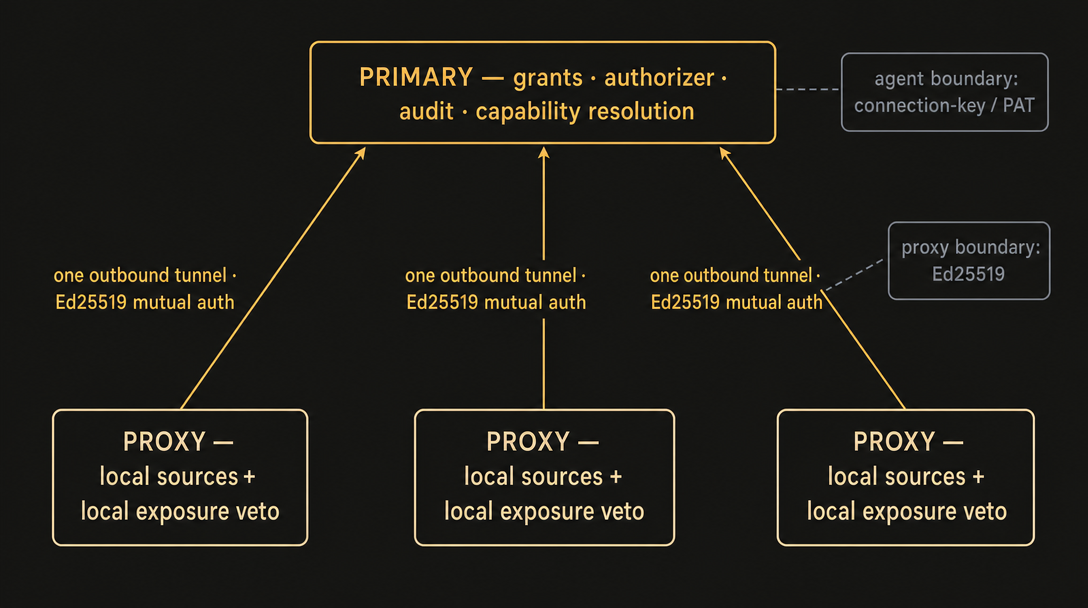
            AGENT (Claude Code / Codex)
              │  connection-key / HS256 JWT   ← trust boundary ①  (UNCHANGED by the mesh)
              ▼
        ┌───────────────┐   HTTP :7077 (agent surface) + admin
        │    PRIMARY    │   holds grants · runs authorizer · audit sink · resolution table
        │  (authority)  │   MAY ALSO bear its own local workload (0-source is just the minimal case)
        └───────┬───────┘
      ws / wss  │  second listener (the "tunnel acceptor") — the proxy DIALS this
   ┌────────────┼───────────────┐   trust boundary ②  (Ed25519 mutual auth — NEW)
   ▼            ▼               ▼
┌────────┐  ┌────────┐     ┌────────┐
│ PROXY  │  │ PROXY  │ …   │ PROXY  │   each bears local sources, keeps a local exposure veto +
│  (m1)  │  │  (m2)  │     │ egress │   local audit, and DELEGATES authorization UP the tunnel
└────────┘  └────────┘     └────────┘
Two orthogonal axes (SSOT §0, Invariant A). Authority mode (primary | proxy) is decided at boot and immutable; workload-bearing (do I expose local caps?) is runtime and independent. A primary may bear its own workload; a proxy may bear none (a pure "egress" router). The mode split in code is a single boot branch:
- Mode is parsed from
PLEXUS_MODEinsrc/config.ts:676(loadMeshBootConfig— note: insrc/, outside the mesh/ code root), defaulting to"primary"; an unknown value orproxywithoutPLEXUS_UPSTREAM_URLfails fast (src/config.ts:684,src/config.ts:698). MeshRuntime.start()branches once:runtime.ts:534→startPrimary()(runtime.ts:556, binds the acceptor) vsstartProxy()(runtime.ts:933, dials out). Everything downstream is wired inside those two methods; the two modes share no live socket wiring.
Configuring a node (env contract). All read in src/config.ts (outside the mesh/ code root):
| Var | Meaning | Read at |
|---|---|---|
PLEXUS_MODE | primary | proxy (default primary) | src/config.ts:676 |
PLEXUS_TENANT | address top segment (default implicit local) | src/config.ts:688 |
PLEXUS_WORKLOAD | this gateway's workload name (proxy declares at enroll) | src/config.ts:689 |
PLEXUS_UPSTREAM_URL | proxy → which primary to dial | src/config.ts:690 |
PLEXUS_UPSTREAM_PUBKEY | proxy → the primary's pinned Ed25519 key (M1, mandatory) | src/config.ts:694 |
PLEXUS_JOIN_TOKEN | proxy → one-time admission token (first join only) | runtime/serve.ts:95 |
PLEXUS_MESH_TUNNEL_HOST / _WS_PORT / _WSS_PORT | primary tunnel bind (default loopback + ephemeral ws) | src/config.ts:622–624 |
PLEXUS_MESH_TLS_CERT / _KEY | primary wss TLS material | src/config.ts:625–626 |
PLEXUS_MESH_REQUIRE_ENCRYPTION | primary refuses plain-ws proxies (default off) | src/config.ts:627 |
2. Enrollment — the one-time join token
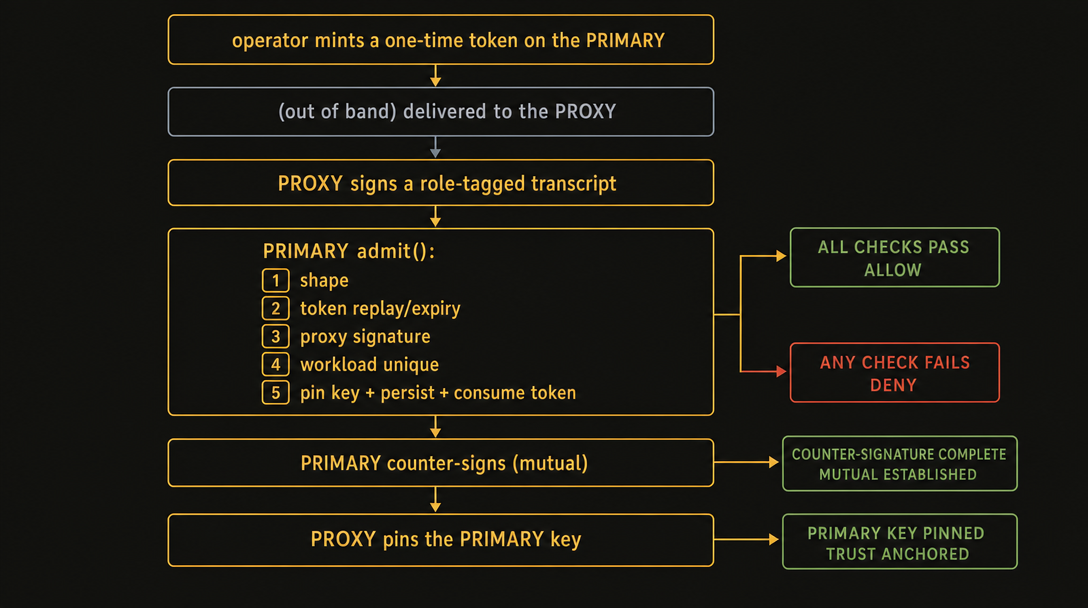
Enrollment is the second trust boundary and is security-critical (enrollment.ts:1–43). It is fully separate from the agent↔primary HS256 wire. All of it is default-deny / fail-closed: any malformed frame, bad/expired/reused token, or bad signature admits nothing and persists nothing.
 PROXY                                             PRIMARY (authority)
 ─────                                             ───────────────────
 (operator runs `plexus mesh mint` →)             mintJoinToken()  → raw 256-bit token
        one-time token delivered OUT-OF-BAND  ◄──  (only sha256(token) ever hits disk)
 buildEnrollRequest(payload, proxyKey)             admit(request, primaryIdentity):
   sign role-tagged transcript  ──{payload,sig}─►   1. claim shape · pubkey importable · mode==proxy
                                                     2. token: replay? → unknown? → expired? → valid
                                                     3. proxy sig verifies (proves key ownership)
                                                     4. workload UNIQUE + active (Inv F)
                                                     5. PIN proxyPubKey, persist active record +
                                                        ZERO-EXPOSURE marker, consume token (fsync)
   verifyEnrollAccepted(...)   ◄──{ok,primaryPubKey,sig}─  primary signs the SAME transcript (mutual)
verify primary sig + enforce the primary-key PIN- Token = nonce, single-use. Each token is fresh 256-bit entropy (
enrollment.ts:377–378) bound into the signed transcript (enrollment.ts:167–176), so a signature/response from one handshake can't be replayed into another. Consumption is atomic on the success path (enrollment.ts:472–474); a replay is caught by theconsumedset (enrollment.ts:427). Only the hash is persisted (enrollment.ts:186, comment 36). - Admission order is deliberate and fail-closed — checks 1–5 at
enrollment.ts:404–493; the token is consumed and the record written only after every check passes. - Durable-before-admit (L1). The consume+pin is
fsync'd before success is reported (persistDurable,enrollment.ts:366–368, called at481); a write failure rolls back the in-memory mutation and returnspersist_failed(enrollment.ts:482–487) so a one-time token can never silently resurrect after a lost write + reload. - Zero-exposure entry (Q3). An admitted workload's caps default hidden —
exposureDefault: "hidden"on the record (enrollment.ts:468), so join ≠ access: exposure + grant still gate. - The durable ledger is
~/.plexus/mesh/enrollments.json,0600, atomic write (enrollment.ts:565–570,350–358). Records are keyed by workload (uniqueness index, Inv F —enrollment.ts:287). - Minting surface. In-process authority is
EnrollmentRegistry.mintJoinToken(enrollment.ts:377); the operator reaches it viaPOST /admin/api/mesh/join-token(core/admin.ts:1276, primary-only 409 otherwise) which also returns the tunnel endpoints + primary pubkey so the proxy env can be assembled in one step. Theplexus mesh mintCLI drives that route (packages/cli/src/mesh-commands.ts; contract intests/mesh-cli-mint.test.ts).
Lineage note
This one-time-token→redeem→pinned-identity+durable-ledger primitive is the pattern the later agent-PAT enrollment reused (the agent↔primary side has its own agentEnrollment.revoke tombstone path, core/admin.ts:865). The mesh enrollment is the original; the shape (token-is-nonce, single-use, tombstone-not-delete) is deliberately shared.
3. Tunnels & transport
The tunnel is a single persistent WebSocket the proxy dials out (SSOT §7 transport premise). Enrollment, catalog push, invoke-forward, audit bubble-up and health all multiplex over it. Code: tunnel.ts (client + server + mux), framing in frames.ts.
- Framing. Every multiplexed message is a
Framefrom@plexus/protocol, JSON-encoded newline-free (frames.ts:32), decoded fail-safe — a malformed frame throws and the hot path catches-and-drops so one garbage frame can't wedge the mux (frames.ts:59–70). Correlation ids (newCorr,frames.ts:73) key request/reply. TheFrameMuxpending map is keyed bycorr(tunnel.ts:144–145);request()stamps + sends (tunnel.ts:175),dispatch()matches a reply to its waiter or routes an inbound request toonRequest(tunnel.ts:202–226). - ws vs wss (dual listener). The
MeshServer(tunnel.ts:345) always binds a plain-wsacceptor (tunnel.ts:438) and additionally awssacceptor when TLS + a wss port are configured (tunnel.ts:439–446). Both run the same connection handlers. - Encryption policy —
encryptedis unforgeable. The flag is not read off the socket; it is baked into which listener accepted the connection:buildHandlers(false)for ws vsbuildHandlers(true)for wss (tunnel.ts:438,444; signaturetunnel.ts:557), threaded into the handshake driver attunnel.ts:572. WhenrequireEncryptionis set, a non-encrypted connection is refused at the first handshake message with typedencryption_required, before any admit/pin and before the token is consumed (handshake.ts:399–405) — so the operator can retry the same token over wss.enc-off(default) keeps plain ws working (back-compat, SSOT Q8). Config fails fast ifrequireEncryptionis set without TLS (src/config.ts:647). - Reconnect resilience (client,
MeshClienttunnel.ts:870):- Exponential backoff, hard-capped:
backoffMs = min(backoffMs*2, max)(tunnel.ts:1181), initial 50ms / max 2000ms (tunnel.ts:53–54), equal-jitter delayraw/2 + rand·raw/2(tunnel.ts:1183). Backoff resets on READY (authenticated), not on socket open (markReady,tunnel.ts:1044–1045; the open handler explicitly does not,tunnel.ts:962–963) — so a rejected/plain-ws/revoked proxy doubles toward the cap instead of storming. - Heartbeat: proxy sends a correlated
ping(or ahealthframe when negotiated) every ~15s with a 5s deadline (tunnel.ts:56–57,1060–1071); a missed pong callsforceReconnect()(tunnel.ts:1077) which closes the socket →handleDown(tunnel.ts:1158) → backoff redial. This converts a silent half-open socket into an observable drop. - Primary-side idle teardown:
lastSeenbumped on every inbound frame (tunnel.ts:627); a connection silent past ~3× the proxy interval is swept + torn down firingonDisconnect(tunnel.ts:529–533) so the resolution table stamps it unavailable promptly.
- Exponential backoff, hard-capped:
- TLS hot-reload.
reloadTls()(tunnel.ts:463) stops + re-serves only the wss listener; on a failed rebind it rolls back to the previous known-good material (tunnel.ts:489–492), and if rollback also fails it lands in a consistent DOWN state and rethrows loudly (tunnel.ts:495–498). The ws listener + HTTP plane are untouched. Rotation procedures inencryption-policy.md§2.
4. Handshake & trust
The raw mux is identity-agnostic; handshake.ts is the gate that authenticates the socket before a single data frame is honored (handshake.ts:1–43). It is driven opaquely by the tunnel via a HandshakeDriver (handshake.ts:135); all crypto lives in handshake.ts, none in tunnel.ts.
Two legs, run lock-step by the dialing proxy (NAT-forced — the proxy speaks first, handshake.ts:382):
 leg 1 (first join only, token in hand):
   proxy → enroll { SignedEnrollRequest }        primary runs LIVE admit() (handshake.ts:409–412)
   primary → enroll-result { EnrollOutcome }      proxy enforces the primary-key PIN (M1)
 leg 2 (EVERY connect — binds THIS socket):
   proxy   → auth-init      { workload, cnonce, healthReporting? }
   primary → auth-challenge { snonce, sig_primary, healthReporting? }   sig over (workload,cnonce,snonce)
   proxy   → auth-response  { sig_proxy }
primary → auth-ok → socket PROMOTED- How a node proves identity. Fresh per-connection nonces make each transcript unique (
authSignedBytes,handshake.ts:177), so a captured signature can't authenticate a different socket. The primary verifiessig_proxyagainst the ledger-pinned key (pinnedProxyPubKeyFor, wiredruntime.ts:613; verifyhandshake.ts:447); an unenrolled / revoked workload has no pin →auth-fail not_enrolled(handshake.ts:443–445). The proxy verifiessig_primaryagainst its mandatory pinnedupstream.primaryPubKey(handshake.ts:304–311) — no bare-TOFU: the driver refuses to even start without it (handshake.ts:218–223, echoed atruntime.ts:942). - Promotion. Only a
donestep promotes the socket to carry frames: server side deletes the pending handshake andregister()s the connection + firesonConnect(tunnel.ts:617–619); a frame arriving on a non-promoted gated socket is closed (tunnel.ts:631–637). - Handshake reaper (DoS guard). The idle sweep only sees promoted connections. An accepted socket that stalls mid-handshake lives in the unauthenticated
handshakesset; the same sweep reaps any entry not promoted withinhandshakeDeadlineMs(default ~10s,tunnel.ts:64,534–546), closing the socket without firingonDisconnect(it was never a workload). Disable withhandshakeDeadlineMs:0. Seetests/mesh-handshake-reaper.test.ts. - Survivability detail (L-1). A lost
enroll-resultafter the token was already consumed by a prior join is not fatal: the proxy seestoken_consumed, treats itself as enrolled, and falls through to the challenge leg, which re-proves against the ledger-pinned key (handshake.ts:274–287). An imposter that never enrolled has no pin, so its challenge still fails closed. All other reject reasons stay fatal.
5. Capability addressing & catalog (provenance-as-address)
Grammar (addressing.ts is the one place it's constructed/inverted, addressing.ts:1–23):
  tenant / <workload-path…> / source.capability
    └ '/' separates LOCATION segments (tenant + variable-depth workload path)
└ '.' separates the source.capability TAIL — today's bare CapabilityId- Address is identity; route is location (Invariant B). The address is the join key that grants
- audit bind to across every lifecycle stage; a bare id never contains
/, so the location prefix and the bare tail are cleanly separable (tail = everything after the last/).
- audit bind to across every lifecycle stage; a bare id never contains
- Primary mount / NAT-for-names (Q4, Invariant F). A proxy is workload-agnostic on the wire: it pushes only bare ids and never embeds its own mesh name, so it's renamable/relocatable without redeploy.
mountAddress(tenant, workload, bareId)prepends the prefix once on ascent (addressing.ts:53–68, throws on a non-bare id — fail-closed against double-mount);forwardTranslate(address)recovers the bare id once at the forward boundary (addressing.ts:79–82). Round-trip law:forwardTranslate(mountAddress(t,w,bare)) === bare. - Catalog ascent / cascade (
catalog.ts). The proxy builds acatalogframe with bare entries —buildCatalogPushasserts every id is bare, fail-closed (catalog.ts:41–63). The primary applies it viaapplyCatalog→registry.mountRemoteWorkload(catalog.ts:81–91), which mounts undertenant/workload/, marks themtransport:"mesh", defaults them zero-exposure / hidden, and bumps the registry revision. - Live ascent + deltas. On every authenticated (re)connect the proxy re-pushes its full catalog (
onAuthenticated → pushCatalog,runtime.ts:986,1021); it also pushes deltas as its local set changes (pushCatalogDelta,runtime.ts:1040) —added/updatedasentries,removedaswithdrawn(the only legitimate un-mount path besides revoke; a transient drop never unmounts — Risk-1). - Anti-forgery on mount. The primary mounts under the socket-bound authenticated workload, never
frame.payload.workload(runtime.ts:796–809) — a forged payload workload is ignored. - v1 depth cap. The grammar is variable-depth (
parseAddresstolerates a multi-segment workload path,addressing.ts:98–107); the operational convention caps depth at 1 via enrollment policy, not grammar, so deeper topologies never force an address migration. Depth >1 (regional delegation, aprimarybehind aprimary) is explicitly out of scope for v1 (SSOT §6).
Cross-reference
This is the provenance-as-address capability-addressing model — address=identity (URN), route=location (URL), glob=scoped-grant grammar, cascade=mount/NAT-for-names. tests/mesh-catalog-ascent.test.ts, tests/mesh-catalog.test.ts pin the contracts.
6. Resolution & invoke forwarding
Through-the-primary equivalence (Q1). The agent talks only to the primary; a mounted address is invoked exactly like a local one and the caller can't tell the origin. Data-plane passthrough is structurally required (not a convenience): content-aware approval needs the authority to see the payload before execution.
The forward path (runtime.ts primary forward boundary runtime.ts:869–929; transports/mesh.ts wiring):
 POST /invoke (primary, mounted address)
   → mesh transport resolves address → { workload, bareId }  via registry.forwardAddress
       (resolveTarget, transports/mesh.ts:82)
   → forwarder.isEnrolledDestination(workload)?   PIN the target — active enrollment only,
       (runtime.ts:871; transports/mesh.ts:146)    no SSRF via a mutable mounted route
   → forwardInvoke(target, address, input, correlationId)   (runtime.ts:877)
       builds invoke frame: FULL address (audited URN) + BARE id (proxy executes) + correlationId
       (runtime.ts:895–904)
   → server.forward(workload, frame)  routes DOWN exactly that workload's socket (runtime.ts:911)
   ─────────────────── over the tunnel ───────────────────►
   PROXY onProxyInbound → executeForwardedInvoke (runtime.ts:1085,1123)
       runs the BARE id through the proxy's OWN InvokePipeline under a synthetic
       TUNNEL-TRUST context (mintTunnelTrustContext, runtime.ts:1132): grant/scope/session
       SKIPPED (primary already authorized — Inv E), but local EXPOSURE VETO + schema/health
       gates + local AUDIT still run (Inv C)
◄─────────────── invoke-result (verbatim InvokeResponse) ──- No replica/failover. A capability has exactly one home (its workload). "Unavailable" means that home is down — the accurate signal, not a DR story.
- Never a hang (Invariant E). A
forwardto a down/absent proxy rejects (MeshDisconnectedError/MeshTimeoutError), caught atruntime.ts:912–921and turned into a typedcapability_unavailablecarryingunavailableSince(how long down). A forward timeout itself stamps the resolution unavailable so subsequent reads agree (runtime.ts:917). - Tunnel-trust ingress is unforgeable. The auth-skip rides a module-private brand mintable only in
executeForwardedInvoke; the agent HTTP surface cannot forge it (runtime.ts:1107–1140). A locally-disabled cap still returnscapability_unexposedeven on the trust path (runtime.ts:1149–1157) — exposure is the resource-owner's veto and always runs. tests/mesh-invoke-forward.test.tsproves forward + bare-on-wire + pinned-destination; the multiproxy fan-out (invoke for A can never reach B's socket) istests/mesh-multiproxy.test.ts.
7. Health reporting (bidirectional, negotiated)
The primary tracks two health facts per workload and resolves route-first:
- Route (coarse,
ResolutionTable,resolution.ts).markAvailableon socket promotion,markUnavailableon drop/close/timeout (resolution.ts:72–90), keyed by workload.unknown= never observed — no socket has ever connected for this workload (resolution.ts:42–43).unavailableSinceis stamped once and preserved across redundant down-signals (resolution.ts:82–90). - Report (fine,
MeshHealthStore,mesh-health.ts). The proxy's aggregated per-source health, pushed up.
- Negotiated at registration, on the challenge leg so it re-runs every (re)connect (
negotiateHealthReporting,handshake.ts:120–127): enabled iff both peers advertise a structurally-valid{version, intervalMs};version=min,intervalMs=max, clamped toMAX_NEGOTIATED_INTERVAL_MS(60s,handshake.ts:90) so a peer can't push the stale window arbitrarily high. A malformed/partial advert is treated as no advert (fail-closed against asetInterval(…, NaN)flood,handshake.ts:100–110). - Reuses the heartbeat, no second timer. When negotiated, the proxy's liveness beat sends a
healthframe instead of a bareping(tunnel.ts:1090–1107); an initial snapshot fires on authenticated connect and an on-change push when a local source flips (reportHealthNow,runtime.ts:998). Primary→proxy is symmetric (cascade + downward liveness),startPrimaryHealthLoopruntime.ts:676. - Anti-forgery.
record(workload, payload)keys on the socket-bound authenticated workload, ignoringpayload.reporter(mesh-health.ts:12,runtime.ts:774–780). A proxy that forgesreporter:"other"only ever updates its own health. - Resolution precedence (
stateFor,mesh-health.ts:160–199): routeunavailablewins (row 1, Inv E) → no report yet ⇒connecting→ stale (older thaninterval×3) ⇒stale→ else the report's aggregate (down/degraded/ok). The wireHealthStatusstays the frozen 4-state; finer distinctions ride indetail(mesh-health.ts:221). - "unknown" specifically surfaces two ways: the route
unknown(never-connected workload,resolution.ts:43), and the wire mapping ofconnecting→status:"unknown"(mesh-health.ts:234). Every mesh-sourced health value is stampedreported:true(mesh-health.ts:213–224) — it is the remote home's unverified self-assertion relayed over the tunnel, never something the primary probed; it stays advisory (route/resolution gates invoke, not the report). Reconnect-epoch handling (a restarted proxy's seq resets to 1 without wedging recovery) isbeginConnection+ the epoch-scoped seq gate (mesh-health.ts:113–116,133–149). - Surfaced at
GET /admin/api/meshworkloads[](core/admin.ts:1255–1269).
8. Revocation & audit cascade
Whole-workload revoke (B6) — revokeWorkload (runtime.ts:733–751), reachable via POST /admin/api/mesh/revoke (primary-only, core/admin.ts:1336). The order is load-bearing and runs the terminal, throwing step first so nothing half-revokes:
 1. TOMBSTONE   enrollment.revoke(workload)  → flip record to terminal "revoked" (fsync; THROWS
                on a failed durable write, BEFORE anything destructive)   runtime.ts:735
 2. UNMOUNT     capabilities.unmountWorkload(workload) → remove its addresses  runtime.ts:737
 3. PURGE       grants.removeForCapability(address) for each unmounted addr    runtime.ts:740–741
 4. DROP        server.dropConnection(workload) → close the live socket        runtime.ts:744
5. STAMP resolutionTable.markUnavailable + stop primary→proxy health runtime.ts:747- The tombstone is what makes revoke terminal:
isActive/pinnedProxyPubKeyFor/isEnrolledDestinationall gate onstatus==="active"(enrollment.ts:541,runtime.ts:632–634,874), so a reconnect with the old pinned key finds no pin →not_enrolled, and the forward boundary refuses it. The row is tombstoned, never deleted (enrollment.ts:511–526), so a replayed/stale token can't resurrect a revoked workload. - Idempotent. Unknown / already-revoked workload →
tombstoned:falsebut steps 2–5 still run as no-ops. Per-grant revocation of a single mounted address stays onPOST /admin/api/revoke(core/admin.ts:625) and leaves the enrollment + mount + tunnel intact (tests/mesh-revocation.test.tscase e). dropConnectionvs teardown. Revocation drops the socket withfireDown=false(tunnel.ts:721) — the workload is being revoked, not merely disconnected, so it doesn't re-run the transient-drop path.
Audit cascade (Invariant D). Each gateway's local log is authoritative for its own caps; the primary keeps a full redacted mirror for single-pane audit, and the bubble-up never blocks the hot path:
- Proxy subscribes to its own audit write path and bubbles a copy up the tunnel as an
auditframe, fire-and-forget + fully swallowed (bubbleAudit,runtime.ts:1066–1074; wiredruntime.ts:1006–1008). - Primary mirrors it best-effort:
mirrorProxyAudit(runtime.ts:833–851) re-stamps authority-owned metadata (tier:"proxy", the socket-bound originating workload — never trusted from the payload) and writes through the same redactor both tiers run, so the mirror can never reveal more than the proxy's local log. A mirror-write failure is swallowed and never delays the ack (runtime.ts:848–850). - The
correlationIdthreads the primary's edge-span to the proxy's workload-span (distinct from the per-frame muxcorr) — passed into the invoke frame (runtime.ts:902) and the tunnel-trust context (runtime.ts:1139).tests/mesh-audit-cascade.test.tsproves same-redactor + shared correlationId + a broken bubble never blocking the invoke.
9. Confinement (in scope; two independent appliances)
Neither is on the mesh wire, but both are how a proxy safely bears a workload.
- Linux exec confinement (
bwrap).platform/sandbox-backend.tsabstracts "run this exec command confined to these paths" behindSandboxBackend;DarwinSandboxBackendwraps the unchanged seatbelt.sbprofile (byte-for-byte identical argv),LinuxSandboxBackendbuilds an equivalent bwrap jail (empty namespace + explicit bind allow-list — the dual of seatbelt(deny default)+(allow subpath)). An availability gate re-activates thecodex/claudecodeexec sources on Linux iff bwrap can actually build a namespace (the probe runs a real jailed command, notbwrap --version, so a present-but-unusable bwrap on a userns-disabled host correctly reports unavailable and the sources stay gated OUT — never "advertised but unjailed"). Full seatbelt→bwrap mapping inlinux-confinement.md. - Containerization appliance ("expose a capability, not a system"). An official minimal container whose entrypoint is
appliance/boot.ts: it reads a manifest (PLEXUS_APPLIANCE_MANIFEST), validates it fail-closed (strict unknown-key rejection; sensitive-path rejection), translates it into the stock env, boots the samestartRuntime, and installs a standing default-deny resolver viaexposure.setDefaultResolverso any capability the manifest doesn't name is hidden at query time — not a boot-time snapshot (closing the scan-race /POST /extensions/list_changedleak). Withupstreamset, the appliance boots as a mesh proxy (dials out, caps ascend undertenant/workload/…, default hidden). Design + threat model incapability-appliance.md.
10. Invariants (A–G) tied to enforcing code
| # | Invariant (SSOT §5) | Enforced by |
|---|---|---|
| A | Mode ⟂ Workload; exactly one primary | Boot branch runtime.ts:534–536; mode parse src/config.ts:676; a proxy may bear no workload (pure egress) |
| B | Address is identity, route is location | Mount/translate seam addressing.ts:53–82; route health never mutates address/grant (resolution.ts:14–17,72–90); no-unmount-on-transient-drop mesh-health.ts:113; Risk-1 in networking-resilience.md §4 |
| C | Effective access = granted ∧ exposed ∧ ¬revoked ∧ coversInput | Local exposure veto runs even on the tunnel-trust path (runtime.ts:1149–1157, core/pipeline.ts); revoke purges grants runtime.ts:740–741 |
| D | Audit local-authoritative + bubbles up, never blocking | bubbleAudit fire-and-forget runtime.ts:1066–1074; mirrorProxyAudit best-effort + same redactor runtime.ts:833–851 |
| E | Authority terminates at the primary; never a hang | Proxies delegate up; tunnel-trust ingress re-decides nothing (runtime.ts:1080–1084); typed capability_unavailable runtime.ts:912–921; forward pinned to active enrollment runtime.ts:871–875 |
| F | Workload unique under parent; addresses cascade-rewritten on ascent | Uniqueness index enrollment.ts:287,456–459; primary mount catalog.ts:81–91, addressing.ts:53–68 |
| G | Companion skill travels with the capability address | Carried in the CapabilityEntry pushed + mounted (catalog.ts:41–91); skills ride the entry up the cascade |
11. Extending the mesh — where to hook in
- Add a transport / change the wire. The
Frameunion is the published language of the boundary (owned by@plexus/protocol);frames.tsowns codec + validation only. To add a frame type: add the variant in the protocol package, extend the codec/validation if it carries bounded data (mirrorvalidateHealthPayload's fail-closed caps,frames.ts:120), and handle it inonPrimaryInbound(runtime.ts:771) and/oronProxyInbound(runtime.ts:1085). The mux (tunnel.ts) is frame-type-agnostic — it carries, never interprets — so a new frame needs no tunnel change. - Add a capability source on a proxy. Nothing mesh-specific: register the source in the normal registry (
core/registry.ts/sources/index.ts); its baresource.capabilityids ascend automatically on the next catalog push (pushCatalog/pushCatalogDelta). If it shells out on Linux and needs a kernel jail, implement it behindSandboxBackendand add an availability gate so it stays gated OUT where it can't be confined (see §9). - Add a new node type / authority topology. Everything hangs off the boot branch (
runtime.ts:534). The grammar already tolerates a variable-depth workload path (addressing.ts:98–107), so regional delegation (aprimarybehind aprimary) composes without new address nouns — but it's out of scope for v1 (SSOT §6.3); wiring a mid-tier that does its own exposure/audit before bubbling up is the real work, not the addressing. - Add an admission or exposure policy. Enrollment admission is one method,
EnrollmentRegistry.admit(enrollment.ts:404) — its check order is the policy seam. Exposure is a per-id resolver (exposure.setDefaultResolver, the same seam the appliance and mesh zero-exposure use), so a new default-deny/allow policy is a resolver, not a code fork. - Observe topology/health.
MeshClient.onStateChange(tunnel.ts:930) for the proxy's own 5-state dial;ResolutionTable.healthOf+MeshHealthStore.stateForfor the primary's per-workload view; both surface atGET /admin/api/mesh.
12. Test map (contracts, not implementation)
| Concern | Test |
|---|---|
| Enrollment admission / replay / durability | tests/mesh-enrollment.test.ts, tests/mesh-join-token-admin.test.ts |
| Tunnel mux / framing | tests/mesh-tunnel.test.ts, tests/mesh-protocol-types.test.ts |
| Handshake mutual auth / trust / reaper | tests/mesh-tunnel-auth.test.ts, tests/mesh-tunnel-trust.test.ts, tests/mesh-handshake-reaper.test.ts |
| Dual listener + require-encryption | tests/mesh-dual-listener.test.ts, tests/mesh-require-encryption.test.ts |
| Reconnect / backoff / heartbeat | tests/mesh-reconnect-resilience.test.ts, tests/mesh-backoff-heartbeat.test.ts |
| Catalog ascent / mount | tests/mesh-catalog-ascent.test.ts, tests/mesh-catalog.test.ts |
| Invoke forward / multiproxy | tests/mesh-invoke-forward.test.ts, tests/mesh-multiproxy.test.ts |
| Health reporting / downtime | tests/mesh-health-reporting.test.ts, tests/mesh-health-downtime.test.ts |
| Revocation + audit cascade | tests/mesh-revocation.test.ts, tests/mesh-audit-cascade.test.ts |
| End-to-end walking skeleton / Linux proxy | tests/mesh-e2e-walking-skeleton.test.ts, tests/mesh-linux-proxy-e2e.test.ts |
Live hybrid demo: bash examples/mesh-demo/launch-mesh-hybrid.sh (native mac primary + 2 Docker Linux proxies, one wss + one ws), admin at http://127.0.0.1:7077/admin.
13. Where the code surprised me vs the SSOT
Small, worth a maintainer's eye — none are bugs, but the SSOT reads as if some are still open:
enrollis a handshake message, not a first-classFrame. The SSOT §7/§3.4 talks about theenrollframe "over the T4 tunnel mux". In code the enroll + auth legs are a separate module-local union keyed byh(handshake.ts:144–151) that rides the raw socket in a pre-mux phase, precisely to keep the mux identity-agnostic. TheFrameunion (keyed byt) only ever flows on an already-promoted socket. This is a cleaner split than the SSOT wording implies.- Audit has no dedicated cross-tier machinery in the tunnel. The SSOT lists an
auditframe and a bubble-up mechanism; in code it's an ordinary correlated request on the generic proxy→primary request path (runtime.ts:783–787,1066–1074) —tunnel.tscarries it, never interprets it. The "cascade" is entirelyMeshRuntime-level, not transport-level. Anyone extending audit should hookruntime.ts, not the tunnel. persist_failedis an enrollment reject reason the SSOT doesn't enumerate. It's the L1 durable-write rollback (enrollment.ts:133,480–487) — a real admission-failure outcome distinct from a bad token/sig. Same for therevokethrow-before-destructive contract (enrollment.ts:511–526); both are "durable-before-report" hardening the DDD invariants imply but don't name.- Health
reported:trueprovenance marker.mesh-health.ts:213–224stamps every mesh-sourced health value as an unverified remote self-assertion. The SSOT frames health as advisory but doesn't surface this on-the-wire marker; it's a meaningful contract for any consumer distinguishing "remote says ok" from a locally-probed "gateway proved ok". unknownhas two distinct sources (never-connected route vsconnecting→unknownwire mapping). Worth stating explicitly in the SSOT health table since a reader could conflate them.